VIII.6.10 Pompeii. Rear entrance to dwelling and peristyle.
Linked to VIII.6.1, VIII.6.9 and 11. Excavated 1819, 1881.
Notizie degli
Scavi, (January) 1882,
p.281, reads –
“Dell’isola
situata a mezzo giorno della 5, e che per la regione esposta di sopra sara da
ora innanzi 6.........”
(“Of the insula situated to the south of 5, which will
now be called 6……,”)
VIII.6.1.8.9.10.11
combined plans
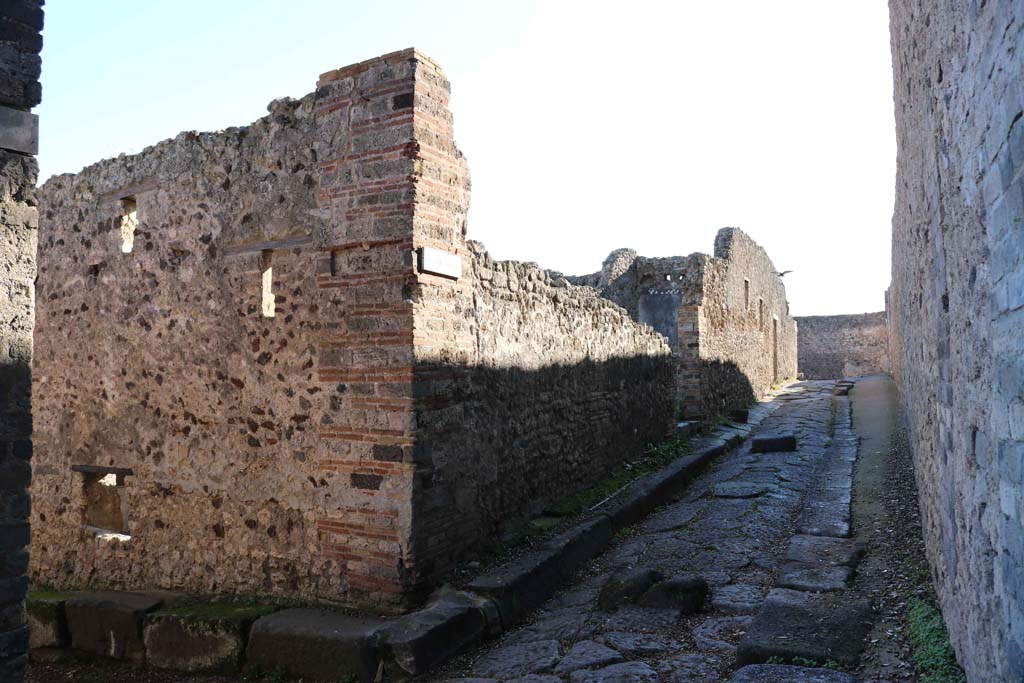
VIII.6.10 Pompeii, in
centre. December 2018.
Looking south on east side of Vicolo dei Dodici
Dei, Pompeii. Photo courtesy of Aude Durand.
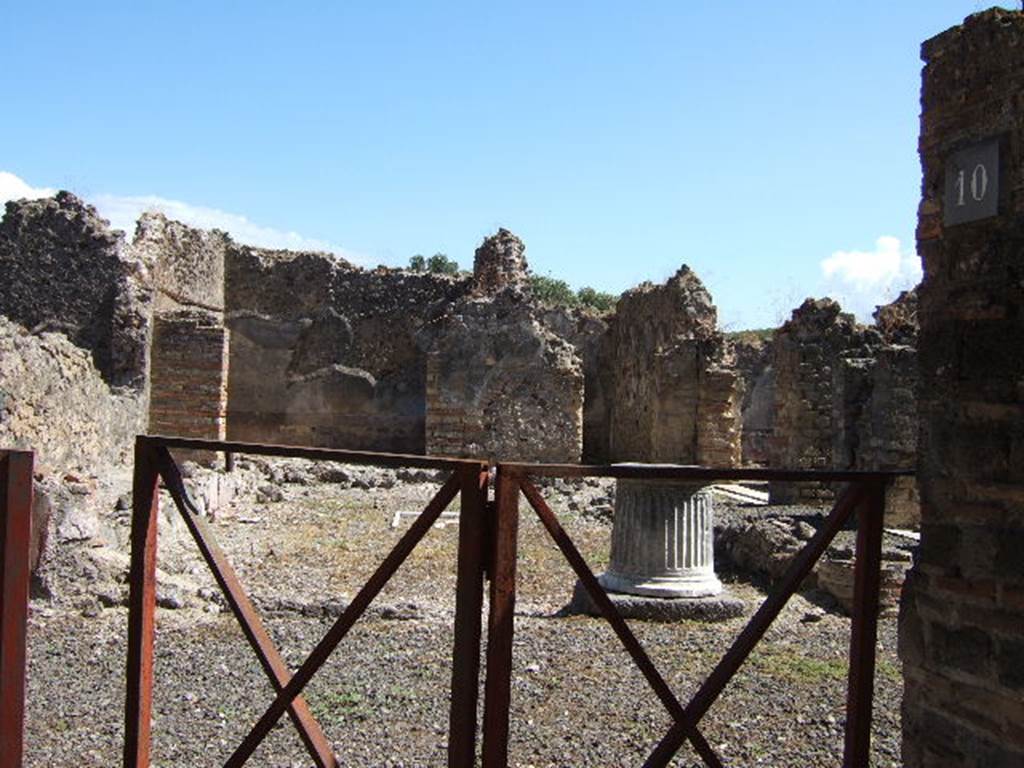
VIII.6.10 Pompeii. September 2005. Looking east from entrance into area of peristyle.
According to Mau, the dwelling of the owner of the bakery was placed around the peristyle.
It had a separate entrance doorway from the western roadway, preceded by a step covered with roof tiles, one of which had a stamp mark.
See BdI, 1884, p.182.
According to Jashemski, the area was not a garden but had a pavement of opus signinum.
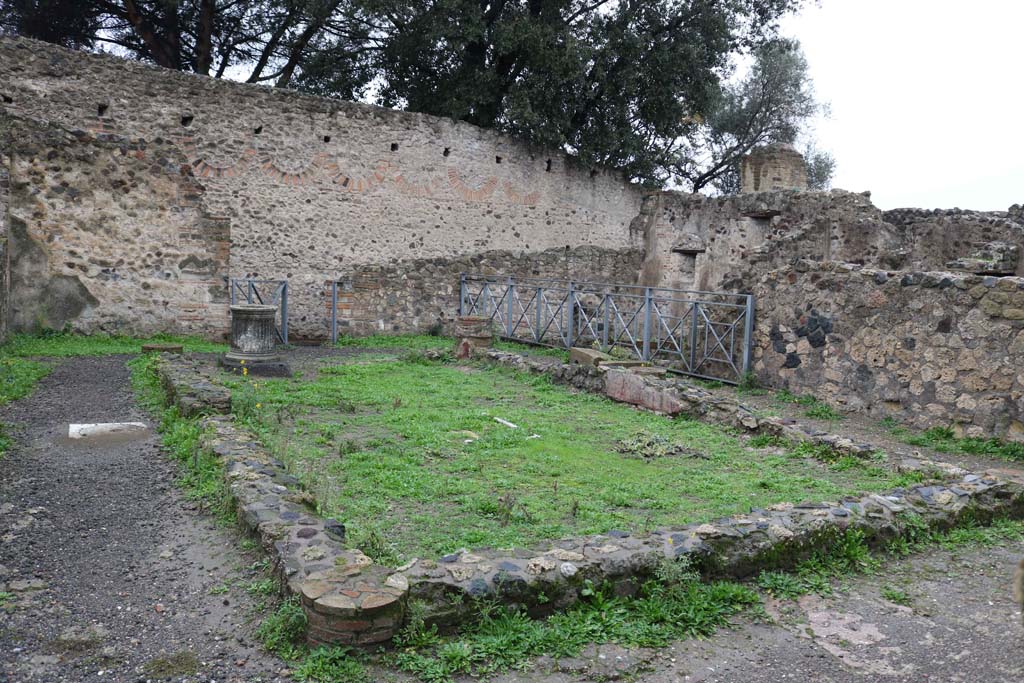
The area was enclosed on all four sides by a portico, supported by three columns on the north and south.
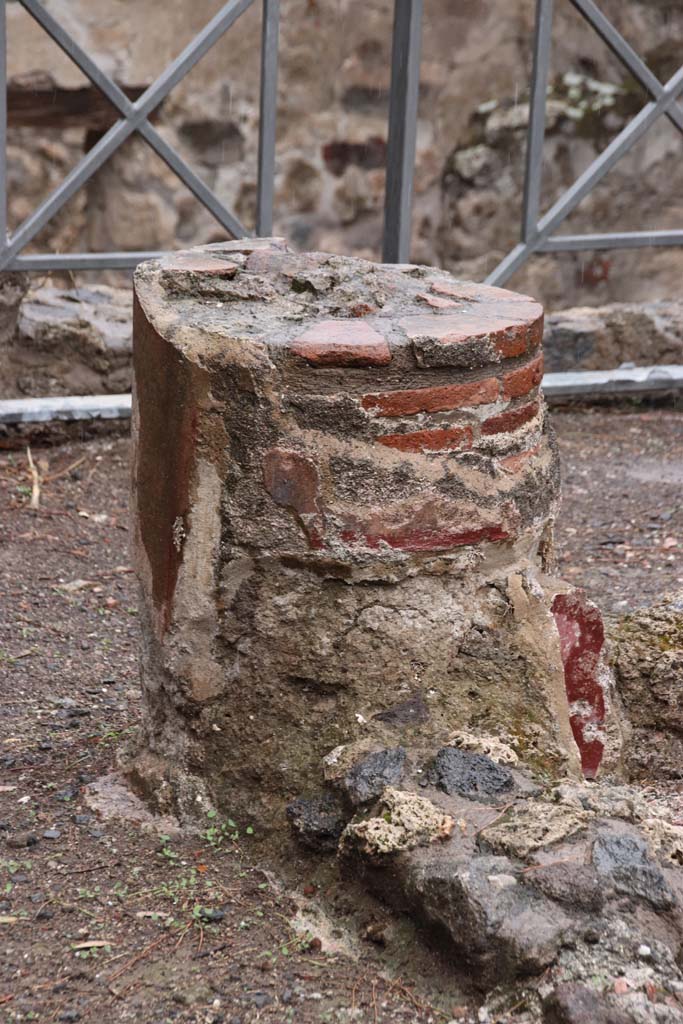
The columns were painted black below, and red above. Today, only the bases of the columns remain.
In the middle of the paved area, according to the reports, there was a rectangle lined with pieces of white and grey marble, in which pieces of yellow marble formed a cross. In the centre of the cross was a little yellow square bordered by a narrow red stripe.
Today it is much damaged.
The various rooms of the house opened off the portico, which could be entered directly from the street at VIII.6.9.
The atrium at the front of the house had been converted into a bakery, VIII.6.1.
See Jashemski, W. F., 1993. The Gardens of Pompeii, Volume II: Appendices. New York: Caratzas. (p.219).
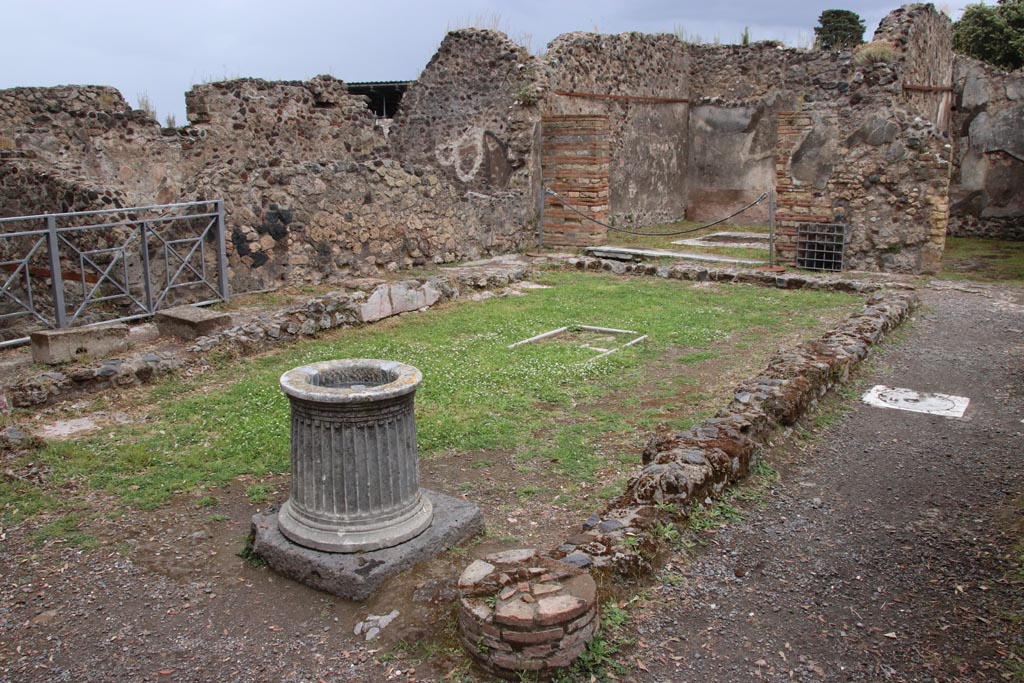
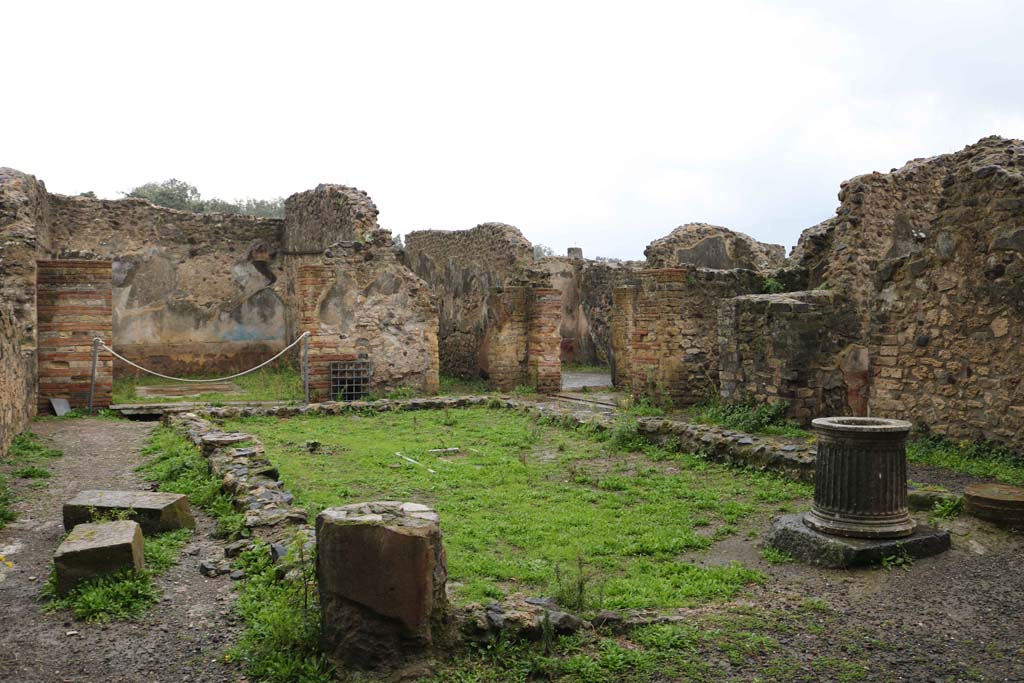
VIII.6.10 Pompeii. December 2018.
Looking east across peristyle towards the doorway to a
triclinium and a storeroom. Photo courtesy of Aude Durand.
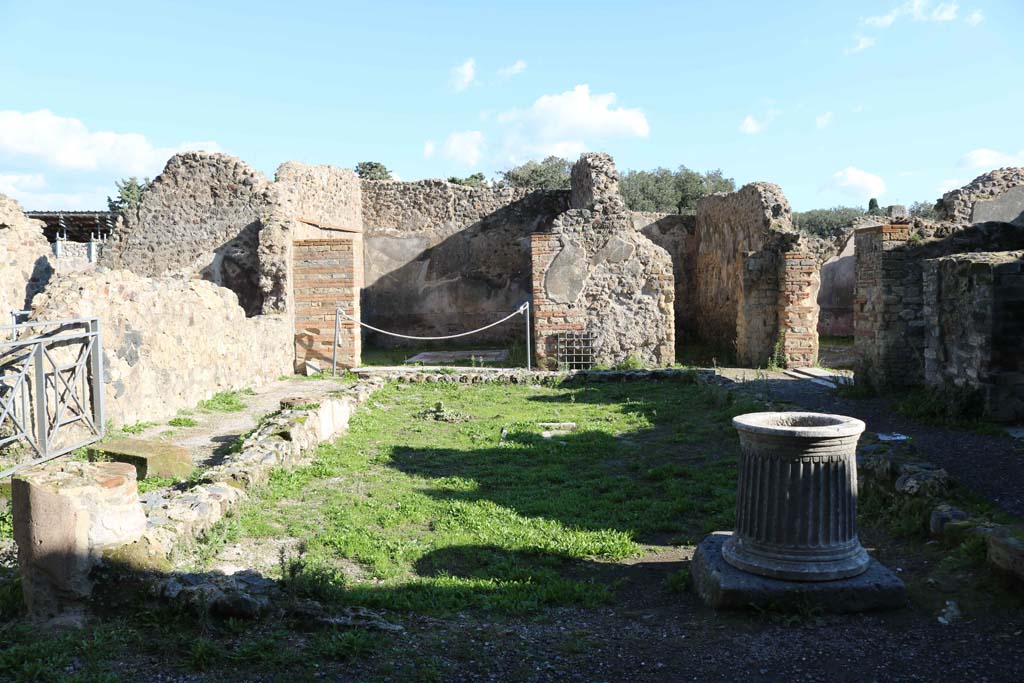
VIII.6.10 Pompeii. 1957.
Looking east across peristyle towards the doorway to a triclinium and a storeroom. Photo by Stanley A. Jashemski.
Source: The Wilhelmina and Stanley A. Jashemski archive in the University of Maryland Library, Special Collections (See collection page) and made available under the Creative Commons Attribution-Non Commercial License v.4. See Licence and use details.
J57f0155
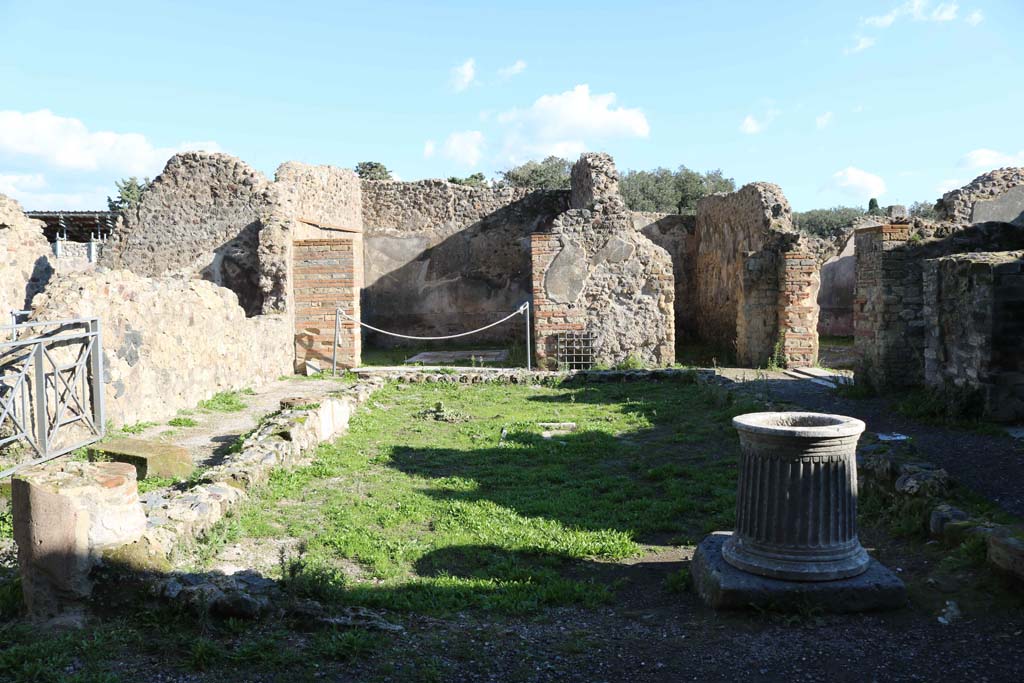
VIII.6.10
Pompeii. December 2018. Looking east from entrance into area of
peristyle. Photo courtesy of Aude Durand.
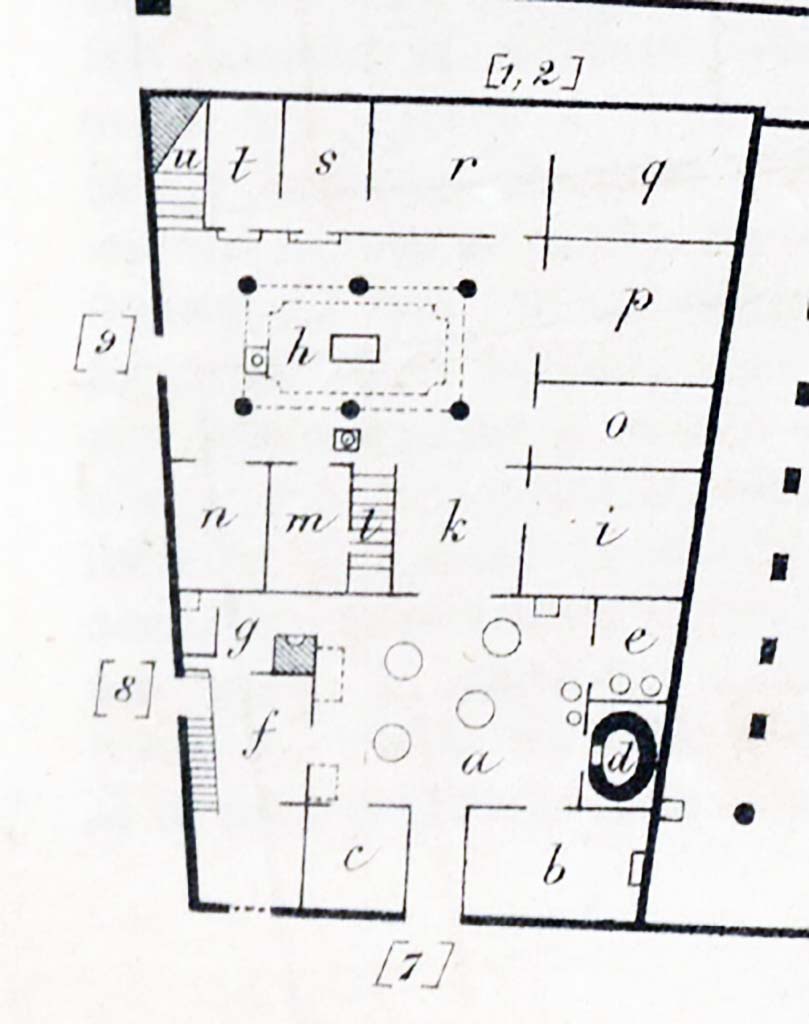
VIII.6.10 Pompeii. September 2005. Looking east from entrance into area of peristyle.
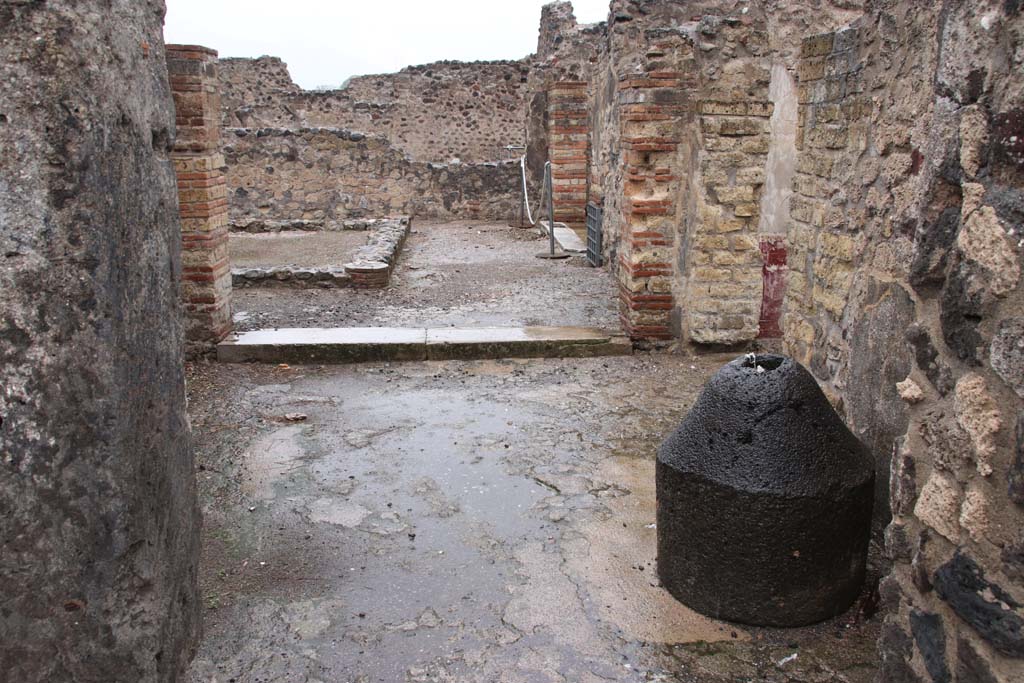
According to Mau, upon entering the doorway, found on the right on the entrance wall was a “boss” in the guise of a pillar.
It was 1.40m wide, 0.30 deep, and 1.15m high.
It had remains of a coating of marble, and on the wall above were the remains of a lararium painting: it was clear, therefore, that this boss served as an altar for offerings to the domestic gods.
However, it seemed in the last times it was destroyed, and that a cylindrical tufa altar (0.32 high, 0.28 diameter) was used instead, this was still lying in the same corner.
See Bullettino dell’Instituto di Corrispondenza
Archeologica (DAIR), 1884, p.183
(Appena
entrati troviamo a destra al muro d'ingresso una sporgenza a guisa di pilastro:
è larga m. 1,40, profonda 0,30, ed era alta 1,15. Conserva avanzi d'un
rivestimento di marmo, e sulla parete sovrastante sonvi quelli della pittura
lararia: è chiaro dunque che questa sporgenza serviva da altare per le offerte
ai Lari. Pare però che negli ultimi tempi fosse distrutta e che invece si
servissero d'un'aretta cilindrica di tufo (a. 0,32, diam. 0,28) che
tuttora si trova nell'angolo stesso).
According to Boyce, there was a projecting base against the wall to the right of the entrance from the street, into the peristyle.
Traces of the original covering with slabs of marble could be seen.
Above it were the remains of the vanished lararium painting.
The top of the pilaster may have served as an altar for offerings.
Found nearby was a small cylindrical altar of tufa.
Mau thought this may have been used instead of the pilaster top, during the last days of the city.
Boyce’s reference - Bull. Inst, 1884, 183.
See Boyce G. K., 1937. Corpus of the Lararia of Pompeii. Rome: MAAR 14. (p.78, no.375)
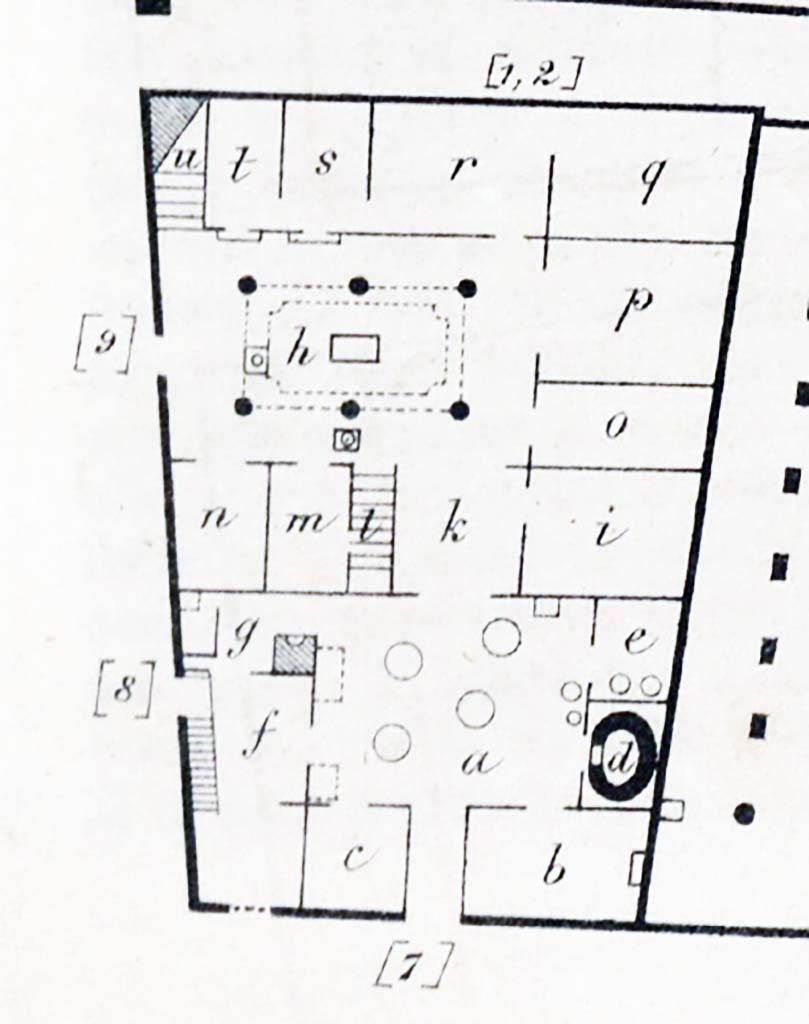
VIII.6.1.10.11
Pompeii. 1883 plan. See Bullettino
dell’Instituto di Corrispondenza Archeologica (DAIR), 1883, p.170.
VIII.6.1.10.11 Pompeii. The plan shows the entrances at VIII.6.1, VIII.6.10 and VIII.6.11 and also shows location of entrances VIII.6.8, VIII.6.9 which are at a lower level.
According to Mau –
of the rooms surrounding the peristyle, rooms “p” and “r” merit the name of triclinium. He could not be precise on the use of room “q”.
Rooms “m”, “n”, “s”, and “t” were bedrooms or storerooms.
Room “o”, he could recognise as a storeroom by the holes for the supports for the two shelves visible in the simply painted white walls, and with the finds such as a bronze saucepan and three coins, three small glass bottles, two terracotta lamps and a long iron paddle, 0.7m long.
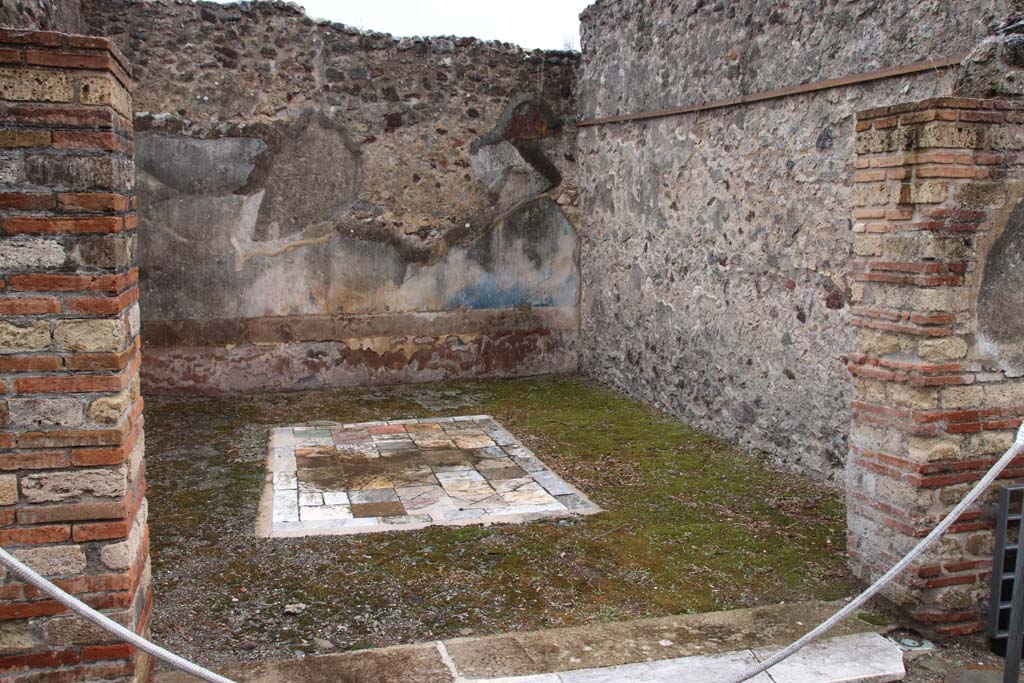
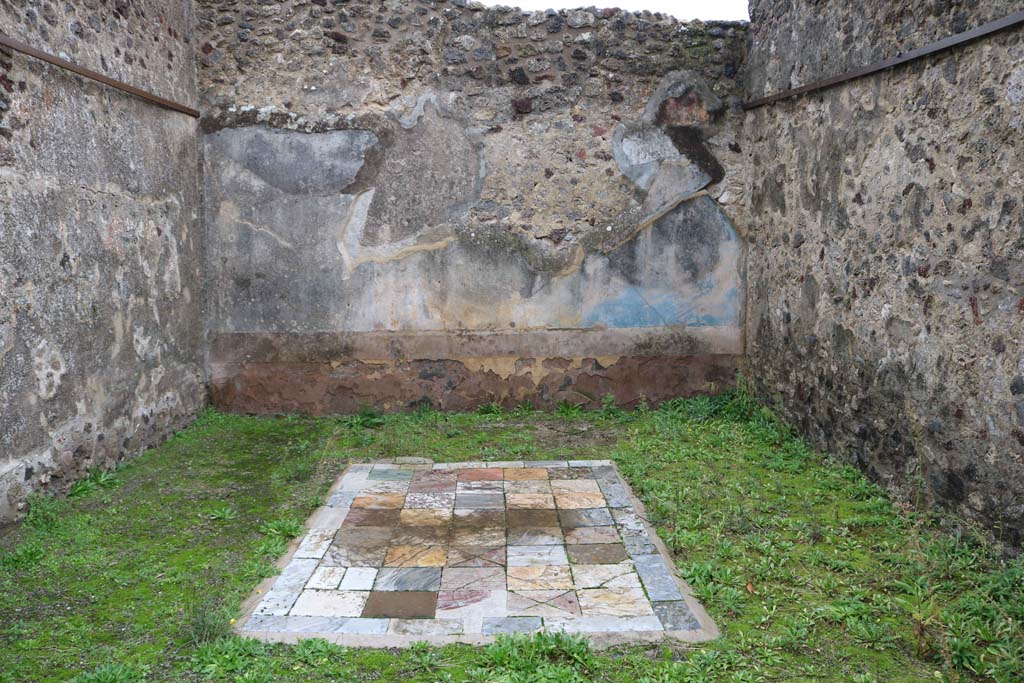
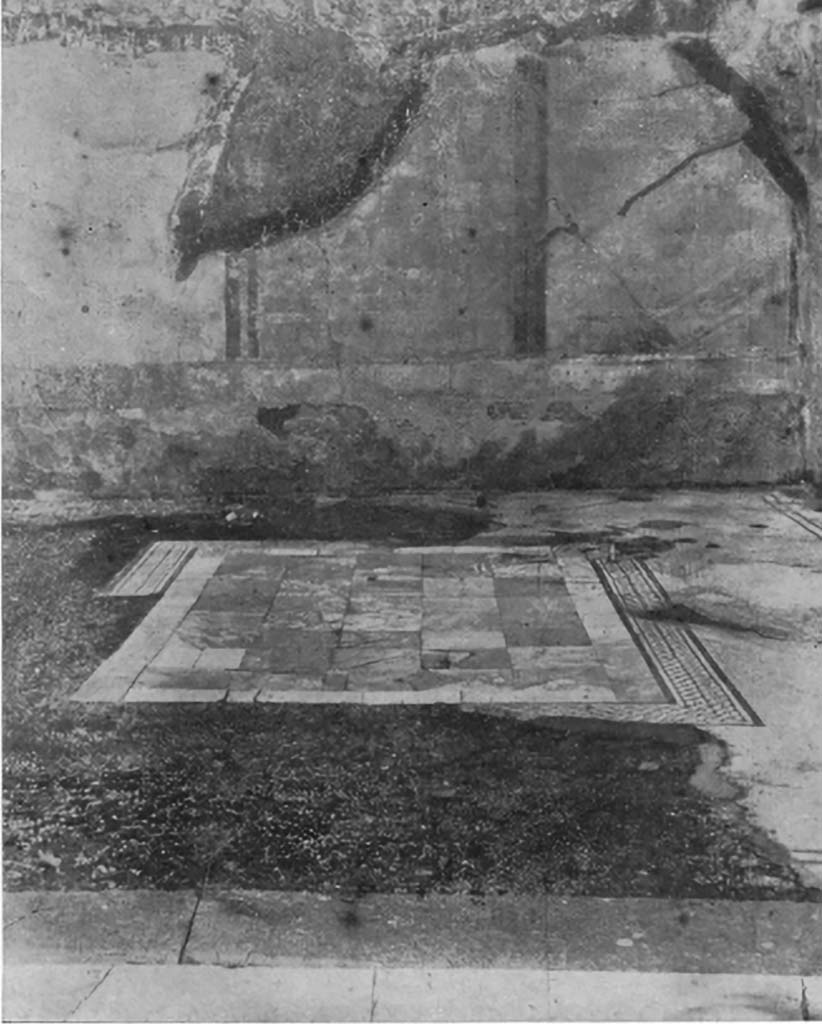
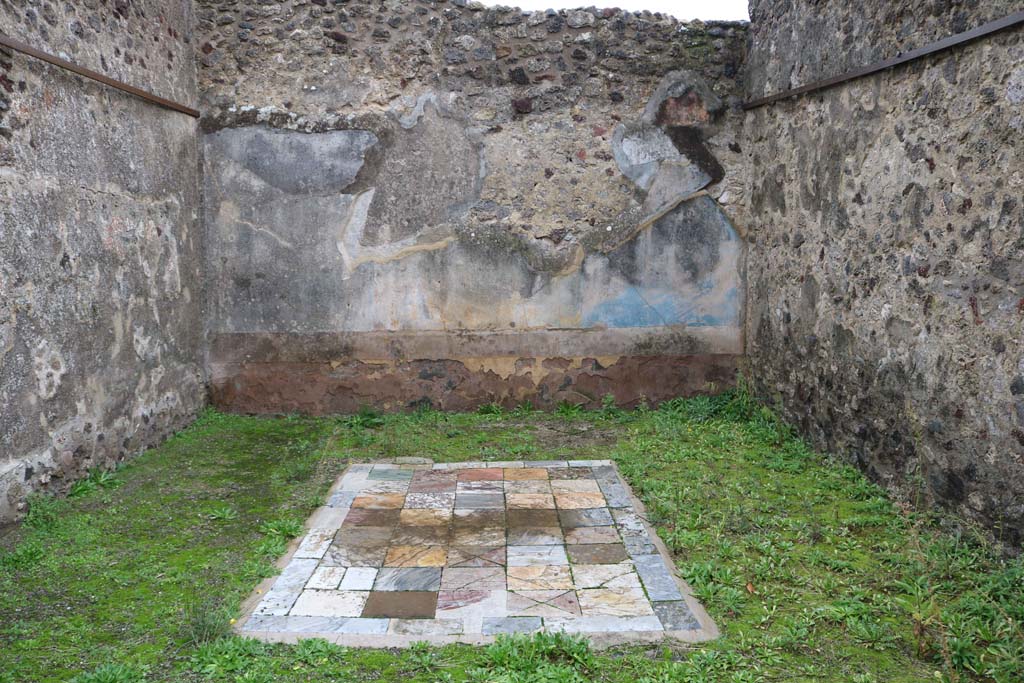
Room “p” was a spacious triclinium, conserved on the rear wall was decoration made in the last style, but without paintings: a yellow panel between two of sky-blue. The floor was of white mosaic with a black margin composed of two narrow strips; in the centre was a rectangle composed of slabs of different coloured marble enclosed in an ornamental strip in the guise of braid. At the doorway were traces of the door-frames and hinges, but not of bolts.
The flooring of the rooms on the left of the peristyle (north side), rooms “r”, “s”, “t”, were found 0.4m above the peristyle, and therefore accessed over a step.
Room “t” was a bedroom, and as such it is recognized from the recess for a bed that is seen in the extreme rear on the right side. It has a small window, which narrows on the outside on the northern roadway. The stucco on the walls is of inferior quality, made from brick dust.
Room “s” is similar but a little larger with the same window. The stucco on the walls is done, as usual, with marble dust. Here was found a wine-jug, a bronze tweezers and a silver coin.
Room "r" has the dimensions of a triclinium and two windows: one similar to rooms "s" and "t" and a larger one. However, the walls have no other decoration than a zoccolo 1.52 m. high, of reddish stucco made by adding brick dust. The floor consisted of a mass similar to opus Signinum with a design formed by white stones. The door is 0.65 m above the floor, and should therefore have been accessible by stairs, which are missing.
In room "q" were some areas of a low ceiling. As however the floor had collapsed (all this part is above the underground basement), nothing more precise could be said about it.
Of the doors around the peristyle, that of "k", "o", "p", had door-frames; that of "k" and "p" had a travertine threshold.
In room “p”, in front of the travertine threshold another lava threshold was placed, from the outside.
In room "m" the threshold is marble, in room "n" of lava.
In rooms "r", "s", and "t", it seems that everything was in the act of reconstruction and that the thresholds were not yet made, although this cannot be verified with certainty because of modern restorations.
See Bullettino dell’Instituto di Corrispondenza
Archeologica (DAIR), 1884, p.183-5.
Secondo Mau; Delle
camere circoniacenti “p” e “r” meritano il nome di triclinii; “m” “n” “s” “t”
sono cubicoli, o un'apoteca, mentre non si può precisare la destinazione di
“q”.
“o” si
riconosce come apotheca per i buchi dei mutuli di due scansie, risibili nelle
pareti dipinte semplicemente a fondo bianco; e con ciò vanno d'accordo i
ritrovamenti fattivi. Vi si raccolse
di bronzo: una
casseruola e 3 monete;
di vetro: 3
piccole bottiglie e una cornice esagona nel esterno e circolare nel mezzo,
larga 0,148;
di terracotta:
2 lucerne;
di ferro: una
paletta lunga 0,7.
“p” è uno
spazioso triclinio; sulla parete di fondo è conservata la pittura fatta
nell'ultimo stile, ma senza quadri: un compartimento giallo fra due celesti. Il
pavimento è di musaico bianco con margine nero composto di due strette strisce;
nel centro un rettangolo formato di lastre di marmo di vari colori rinchiuso in
una striscia ornamentale a guisa di treccia. Alla porta sonvi le tracce di
antepagmenta e di cardini, ma non di catenacci.
Il pavimento
delle camere a sinistra del peristilio, “r”, “s”, “t”, s'inalza di m. 0,4 sopra
quello del peristilio, e perciò vi si accede sopra un gradino. Però ciò rimonta
ad un cambiamento posteriore, come risulta dagli avanzi della decorazione delle
pareti (simile a quella di “m” ma meno conservata) che son visibili in “s” e
“t”.
“t” è
cubicolo, e come tale si riconosce dall' incavo per un letto che si osserva
nell'estremità posteriore del lato destra. Ha una piccola finestra, che si
restringe nella parte esterna, sul vico N. Lo stucco delle pareti è di qualità
inferiore, fatto cioè con polvere di mattoni.
“s” è simile
ma un poco più grande, con finestra uguale.
Lo stucco
delle pareti è fatto, come al solito, con polvere di marmo. Vi si raccolse un
nasiterno ed una pinzetta di bronzo e una moneta d'argento.
“r” ha le
dimensioni d' un triclinio e due finestre: una come quelle di “s” e “t” e una
più grande. Però le pareti non hanno altra decorazione che uno zoccolo alto m.
1,52 di stucco rossastro per l'aggiunta di polvere di mattoni. Il pavimento
consiste di una massa simile all' opus Signinum con un disegno formato da
pietruzze bianche. La porta sta di m. 0,65 sopra il pavimento, e doveva perciò
essere accessibile per gradini, che però mancano.
In “q” erano
alcune località dal soffitto basso. Siccome però il pavimento è sprofondato
(tutta questa parte sta sopra il sotterraneo), così niente di più preciso si
può dire intorno ad esso.
Delle porte
intorno al peristilio quelle di “k”, “o”, “p”, avevano antepagmenta; quelle di
“k” e “p” avevano la soglia di travertino, avanti alla quale ne era stata messa
in “p” un'altra, dalla parte esterna, di lava.
In “m” la
soglia è di marmo, in “n” di lava.
In “r”, “s”,
“t”, pare che tutto fosse in ricostruzione e che le soglie non fossero ancora
messe, benché ciò non possa verificarsi con certezza a causa dei restauri
moderni.)
Ved. Bullettino dell’Instituto di Corrispondenza
Archeologica (DAIR), 1884,
p.183-5.
VIII.6.10 and VIII.6.11 Pompeii. October 2020.
Looking north from
bakery room across room “k”, towards rooms around peristyle. Photo courtesy of
Klaus Heese.
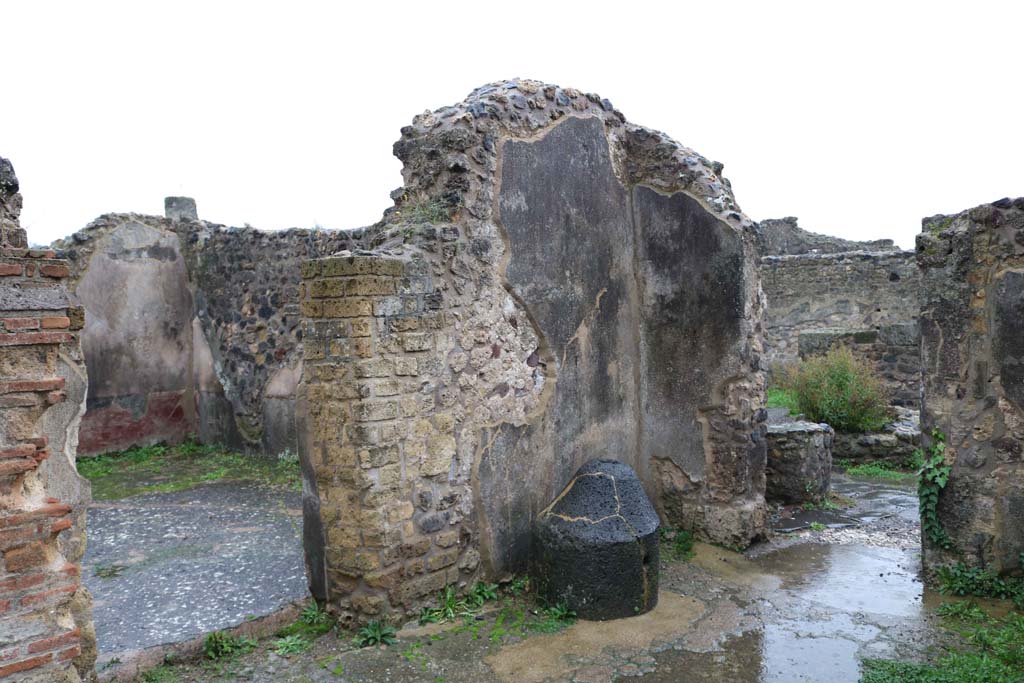
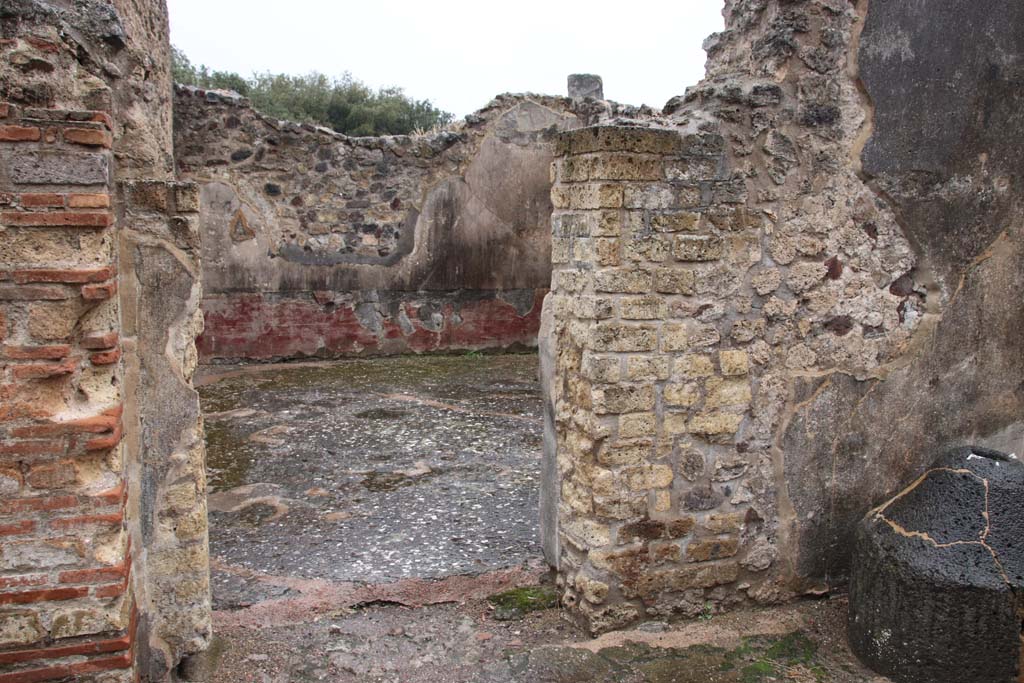
VIII.6.10 Pompeii. October 2020. Doorway to room “i”, on east side of room “k”. Photo courtesy of Klaus Heese.
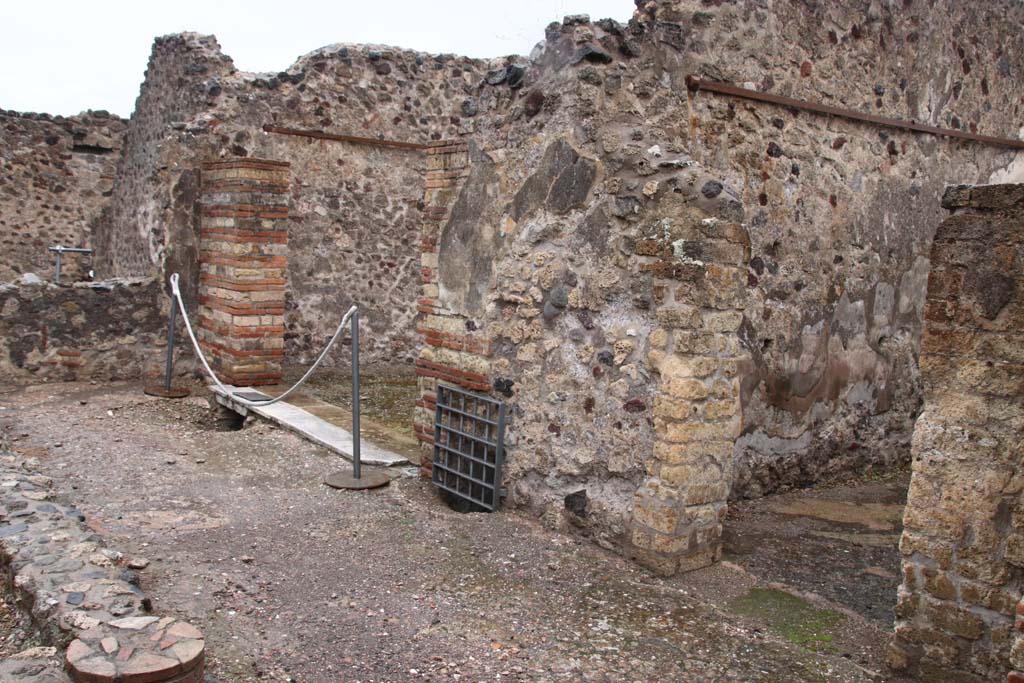
VIII.6.10 Pompeii. December 2018.
Looking across room
“k”, towards doorway to room “i”, on left, and into bakery room at VIII.6.1/11,
on right. Photo
courtesy of Aude Durand.
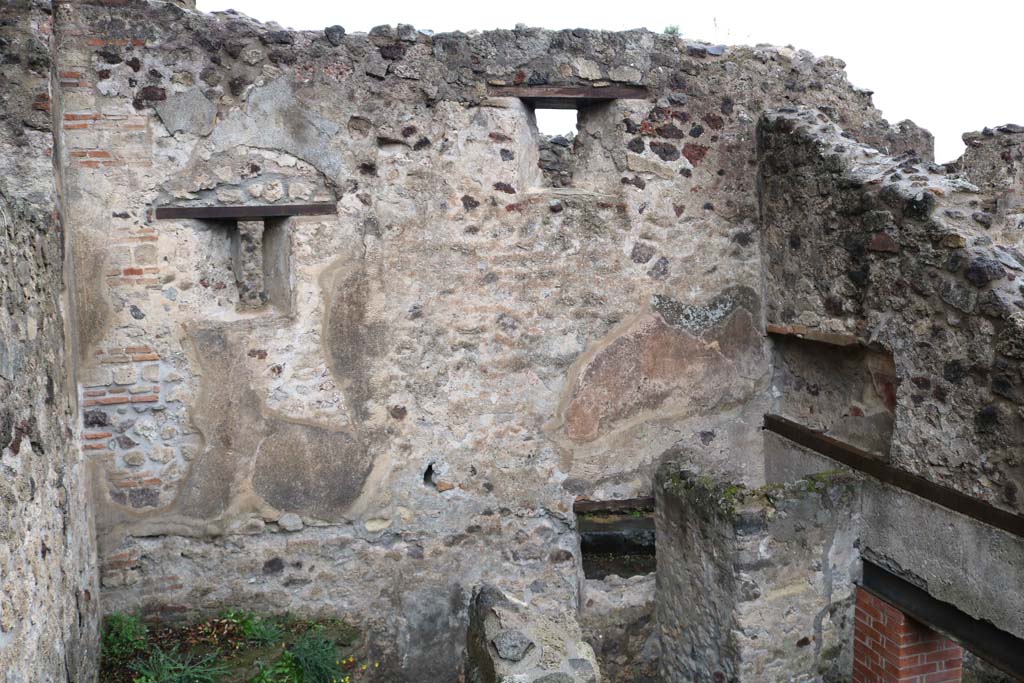
Room “i”, looking south-east
through doorway, Photo courtesy of Klaus Heese.
Room “i”, painted decoration
on north wall at west end near doorway. Photo courtesy of Klaus Heese.
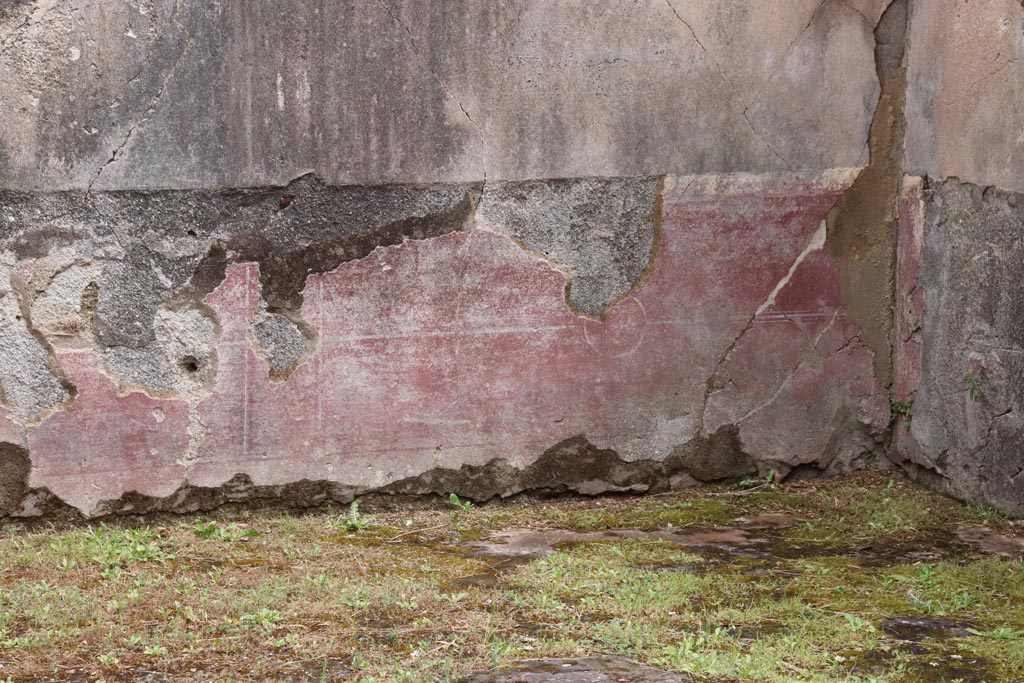
Room “i”, detail of painted
decoration on zoccolo of lower east wall at north end. Photo courtesy of Klaus
Heese.
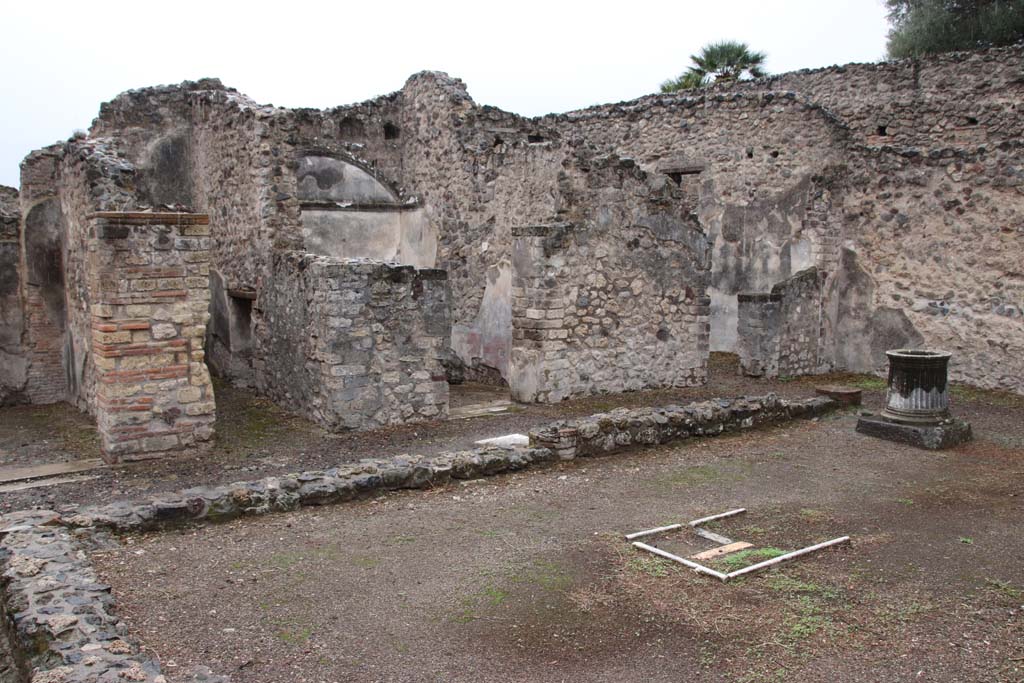
Room “i”, detail of painted
decoration on zoccolo of lower east wall at south end. Photo courtesy of Klaus
Heese.
VIII.6.10
Pompeii. May 2024.
Looking east towards
doorways to room “o”, on left, and room “i”, on right. Photo courtesy of Klaus
Heese
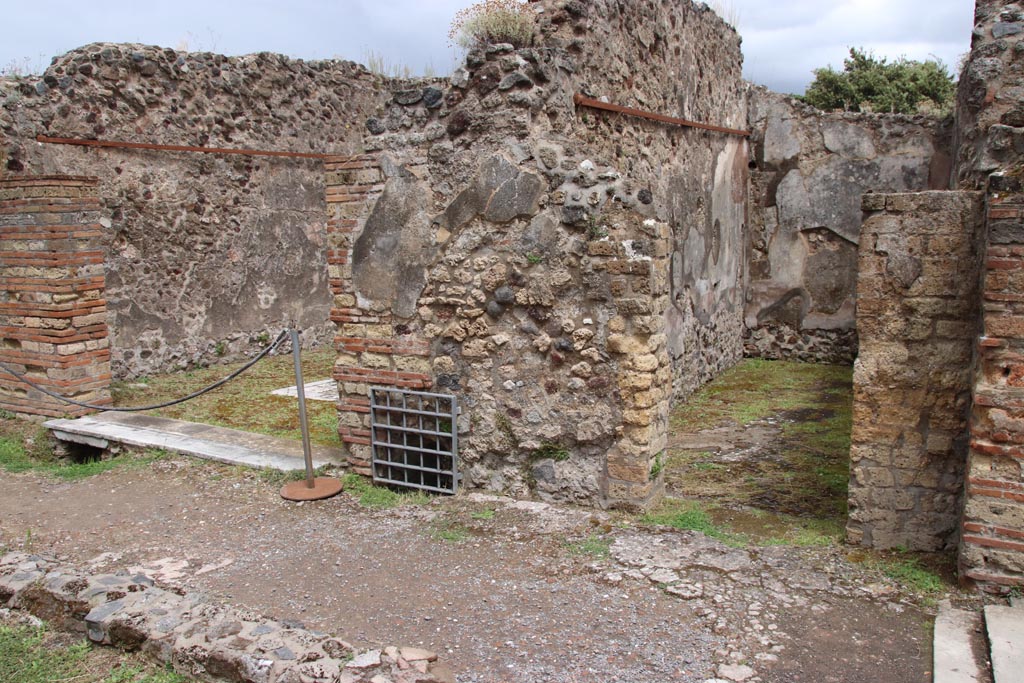
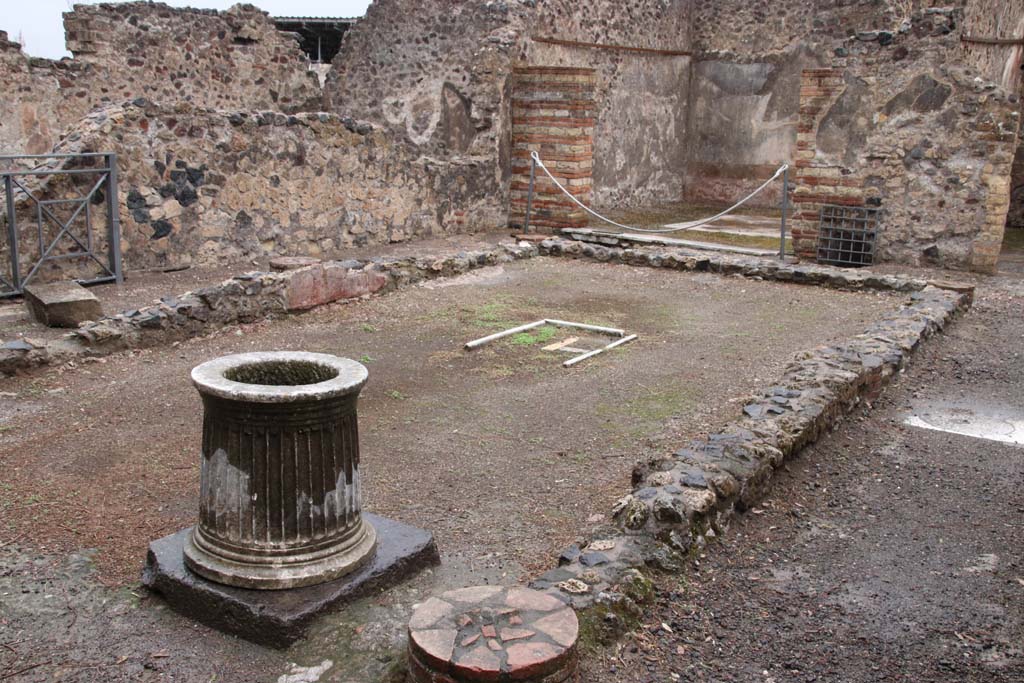
Looking towards east side of peristyle area,
with doorways to room “p”, on left, and room “o”, on right. Photo courtesy of
Klaus Heese
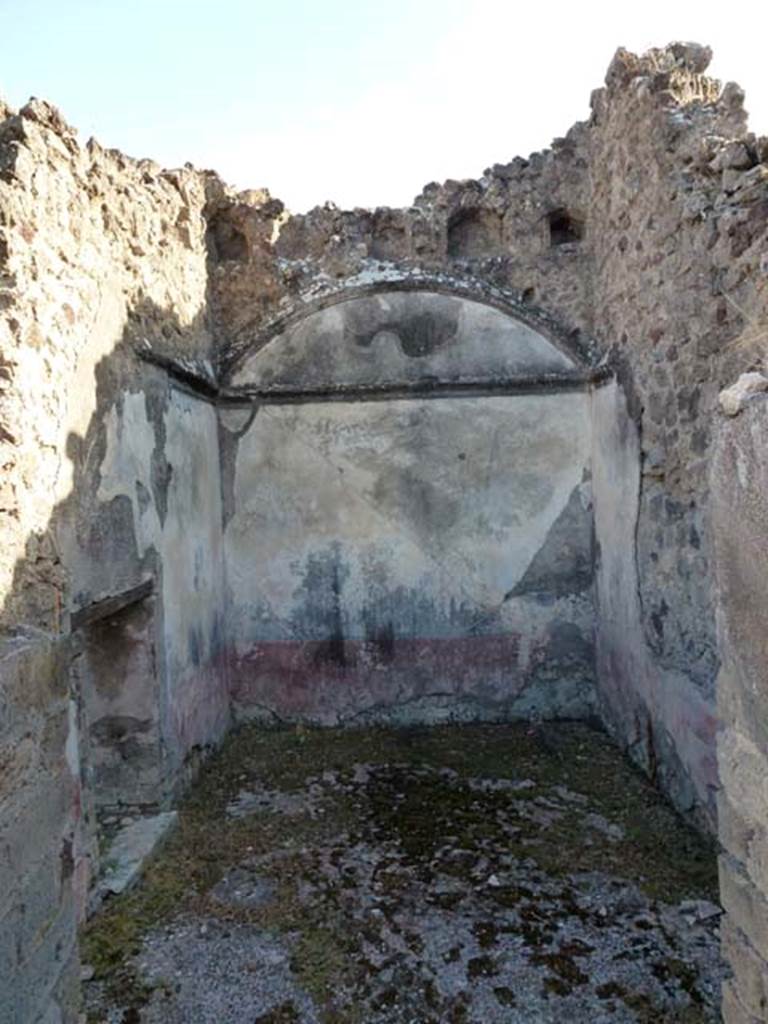
VIII.6.10 Pompeii. October 2020.
Looking east through doorway of room ‘o’. Photo courtesy of Klaus Heese.
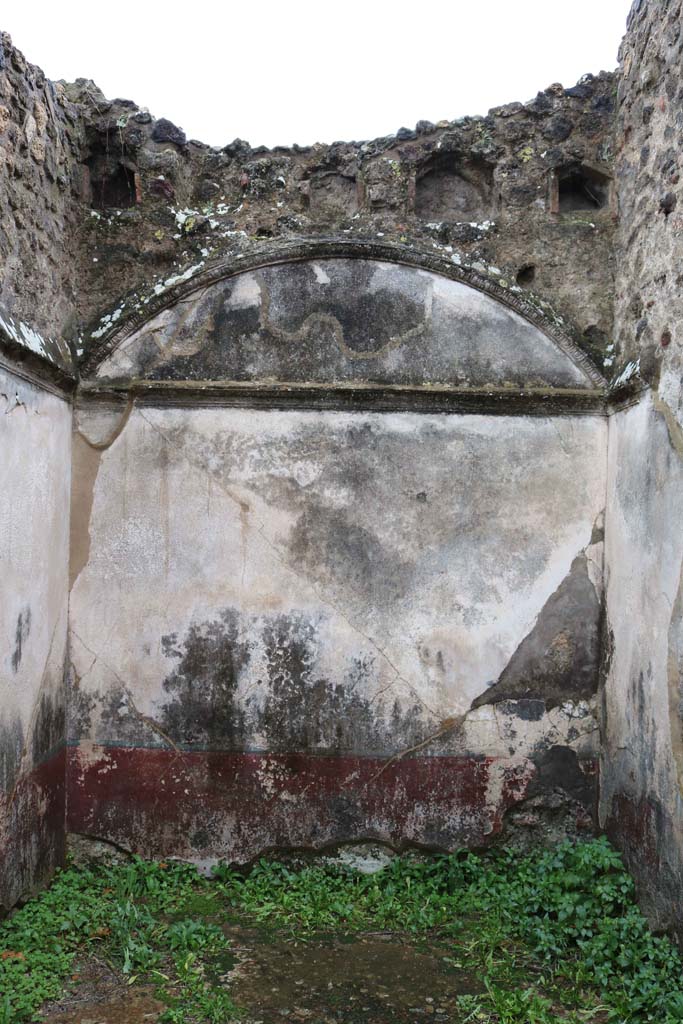
VIII.6.10 Pompeii. May 2024. Looking east across room “p”, a triclinium. Photo courtesy of Klaus Heese.
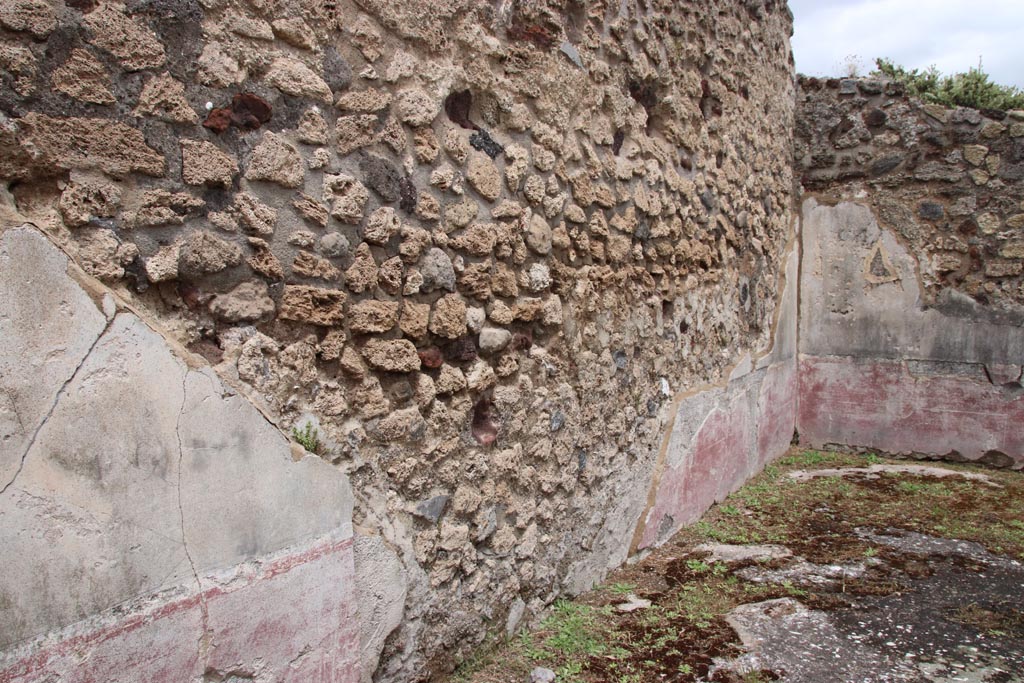
Room “p”, looking towards east wall at south end with remaining painted plaster. Photo courtesy of Klaus Heese.
VIII.6.10 Pompeii. December 2018. Looking
east in room “p”, a triclinium. Photo
courtesy of Aude Durand.
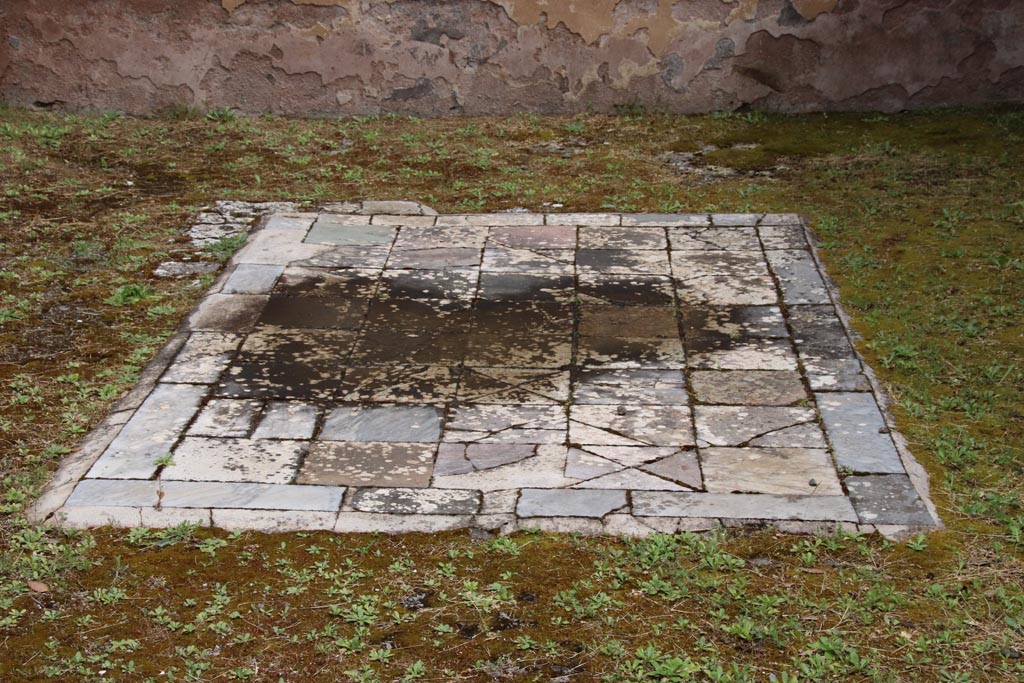
VIII.6.10 Pompeii. May 2024.
Looking east across central emblema in triclinium ‘p’. Photo courtesy of Klaus
Heese.
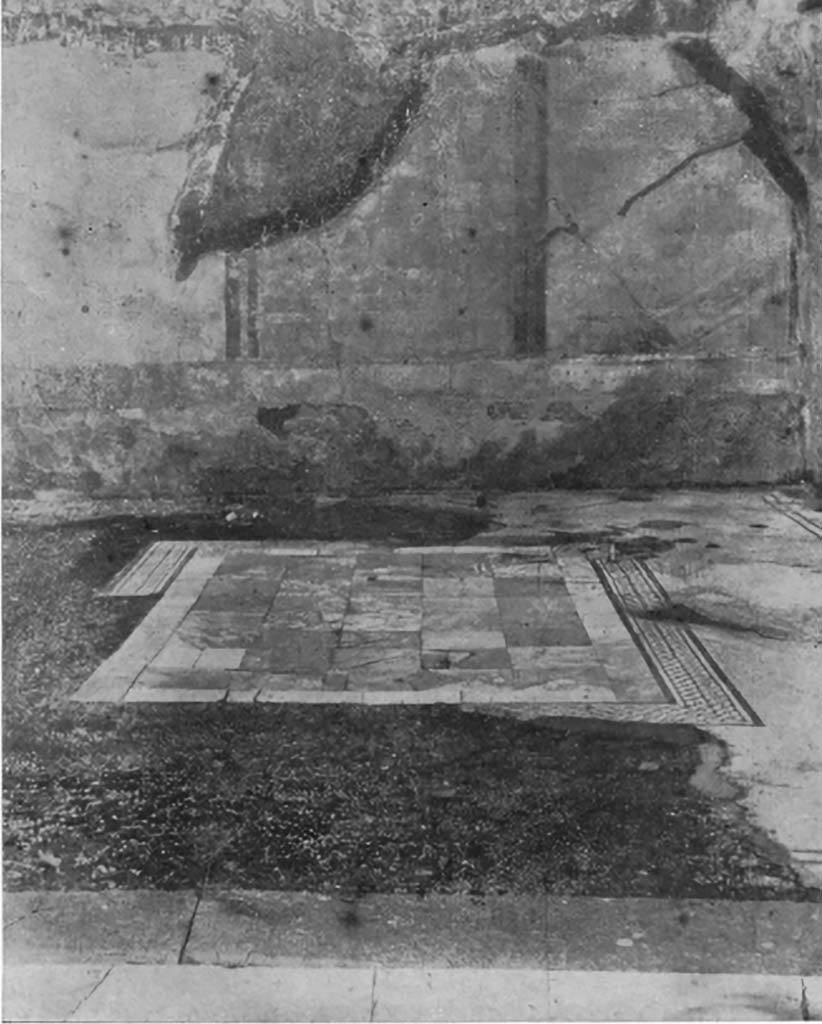
VIII.6.10 Pompeii. c.1930.
Looking across flooring in triclinium ‘p’, shown as a central emblema in opus sectile set in a white mosaic with border of two black lines.
See Blake, M., (1930). The pavements of the Roman Buildings of the Republic and Early Empire. Rome, MAAR, 8, (p.44f, & Pl.8, tav.2, as VIII.6.1)
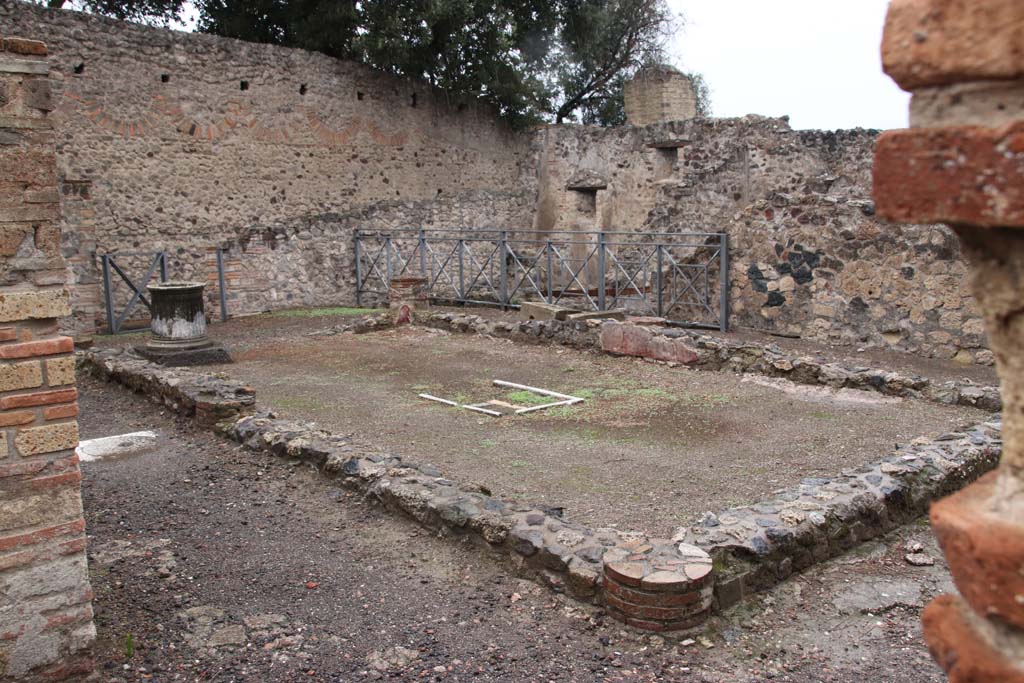
VIII.6.10 Pompeii. October 2020. Looking north-west across peristyle area. Photo courtesy of Klaus Heese.
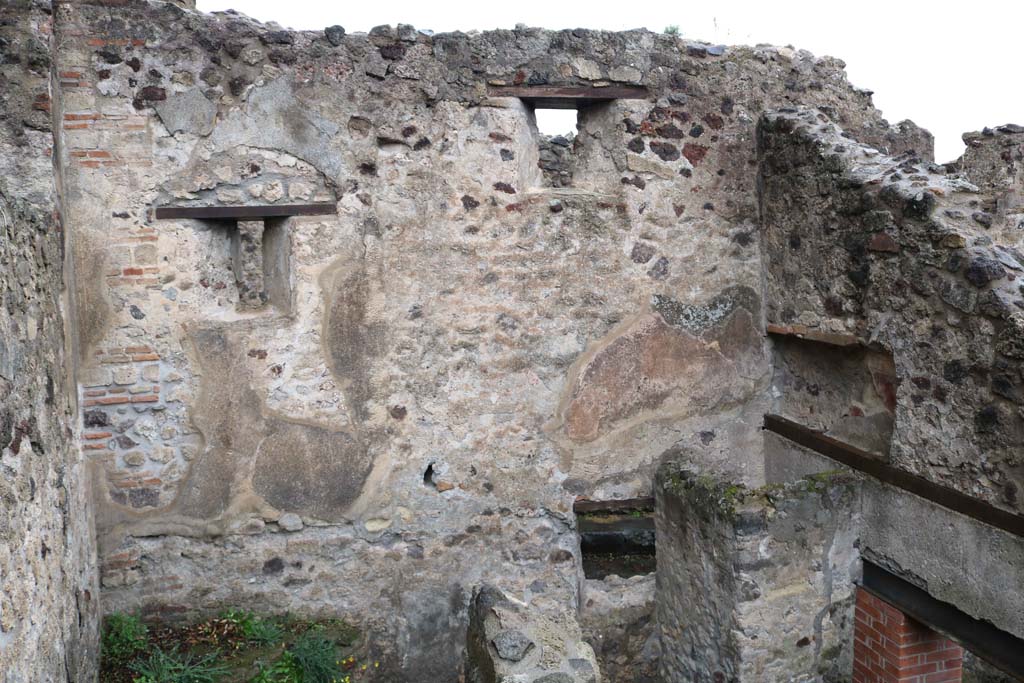
Room
“t”, a cubiculum with recess in the east wall and a small window in the north
wall, is on the right (without a floor).
Photo
courtesy of Aude Durand.
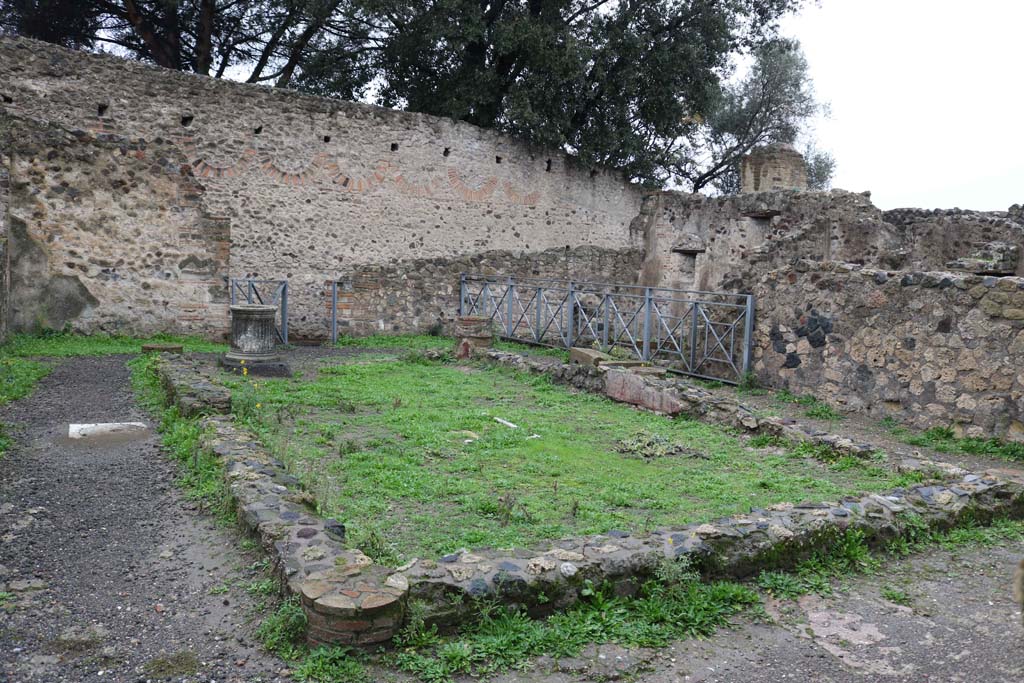
VIII.6.10 Pompeii. December 2018. Looking west
across peristyle area, towards entrance doorway. Photo courtesy of Aude Durand.
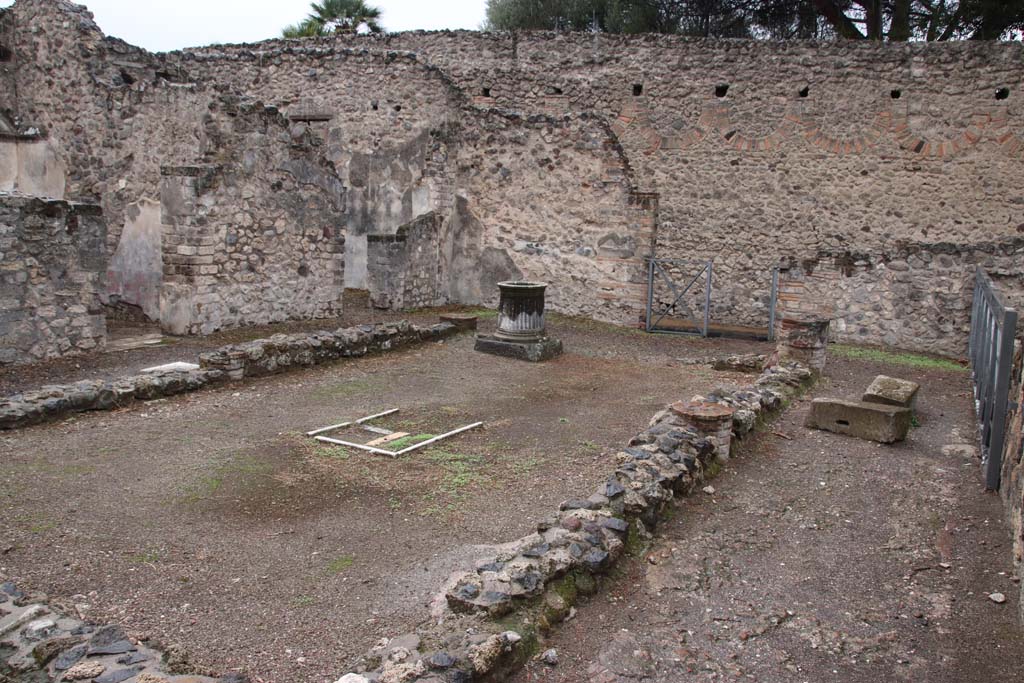
VIII.6.10 Pompeii. October 2020. Looking south-west across
peristyle area. Photo courtesy of Klaus Heese.
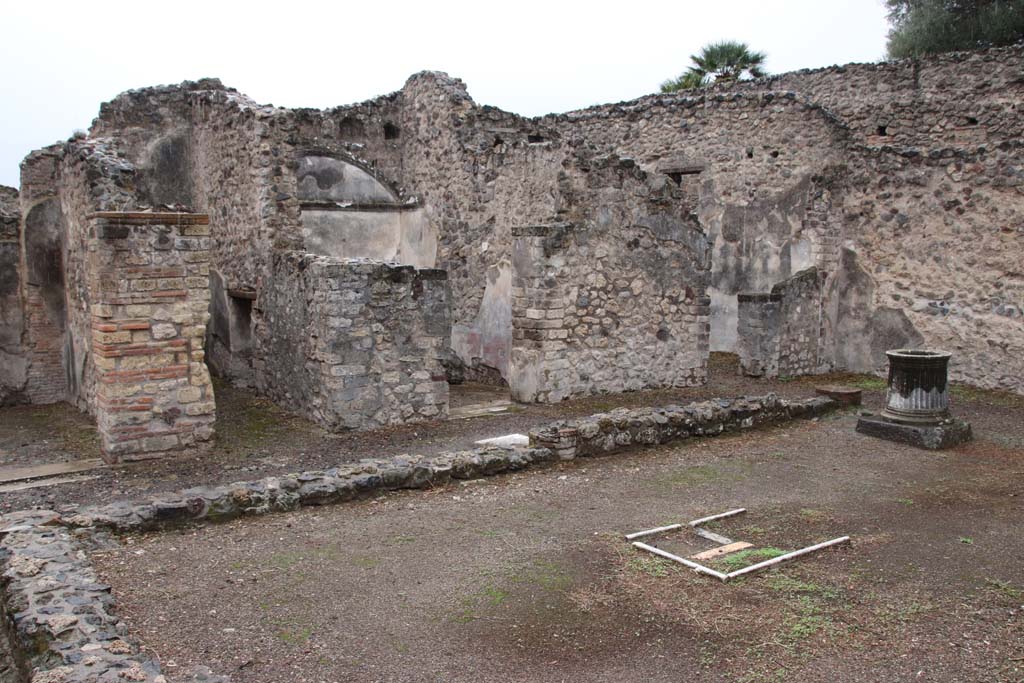
VIII.6.10 Pompeii. October 2020.
Looking towards south side of peristyle area, with doorways
to rooms “L”, stairs to upper floor, “m” cubiculum, in centre, and “n”, another
cubiculum with window onto vicolo. Room “k” is on the left, linking to bakery
rooms in VIII.6.11. Photo courtesy of
Klaus Heese
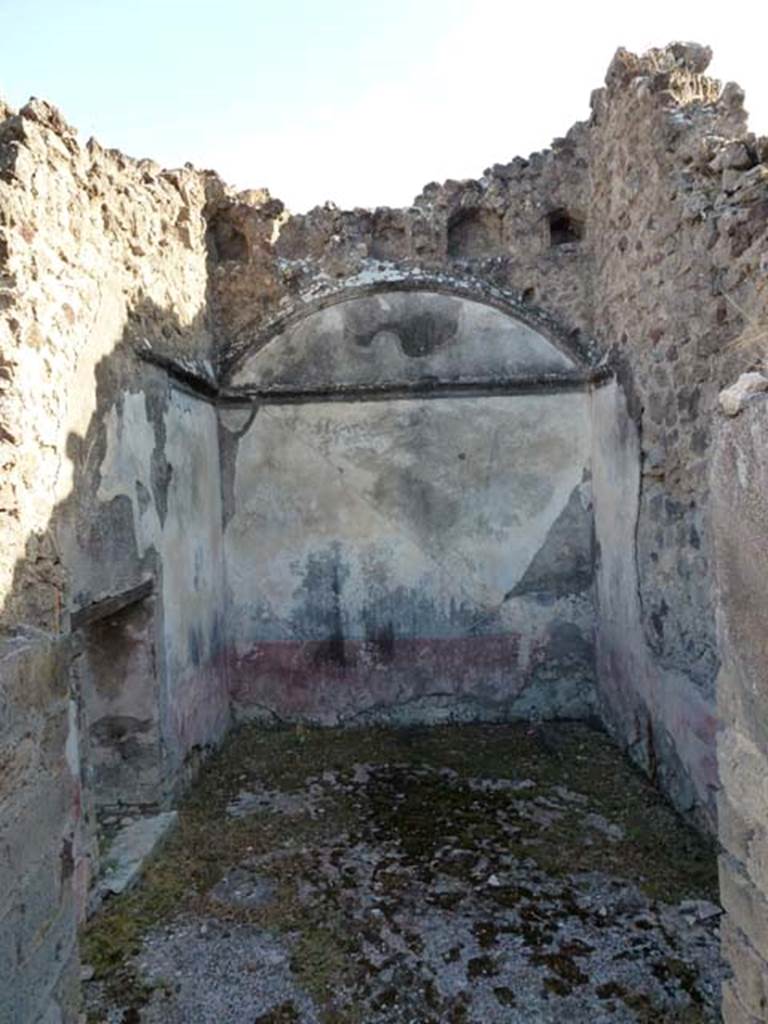
VIII.6.10 Pompeii. September 2011. Looking towards room “m”, on south side of peristyle.
In the south-west corner of the peristyle were two bedrooms.
According to BdI, room “n” –
with a window onto the western vicolo was perhaps the bedroom of a servant.
The walls were crudely painted in the latest style with red zoccolo, and a white background.
The floor was made of material similar to opus signinum, while part of the floor was composed of pieces of travertine.
In room “m”, -
the place of the bed was covered by a vaulted ceiling.
The walls had a simple decoration: a dark red zoccolo which ended at the top with a narrow green stripe, above this the walls were white.
On top of the white walls was a white cornice which was under a narrow blue frieze.
There is no doubt that this decoration must be attributed to the time of the Third Style.
A narrow door joined room “m” to the room that remained under the stairs at “L” by which you reached the upper floor.
See Bullettino dell’Instituto di Corrispondenza
Archeologica (DAIR), 1884, p.184.
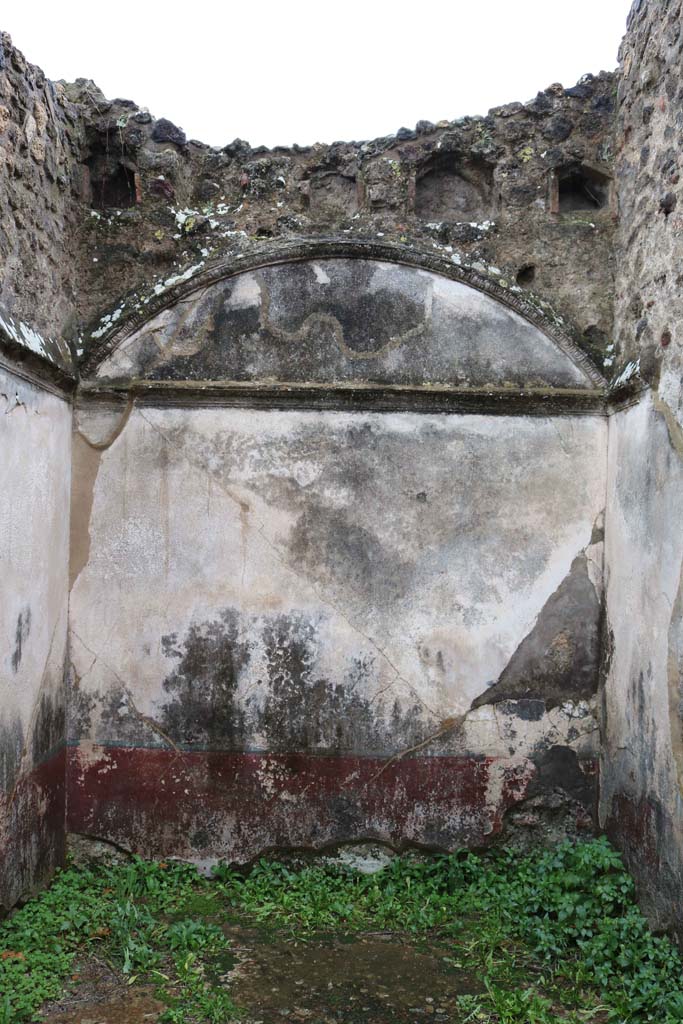
VIII.6.10 Pompeii. December 2018. Room “m”,
south wall. Photo courtesy of Aude Durand.
VIII.6.10 Pompeii. December 2018. Looking east
across north side of peristyle. Photo courtesy of Aude Durand.
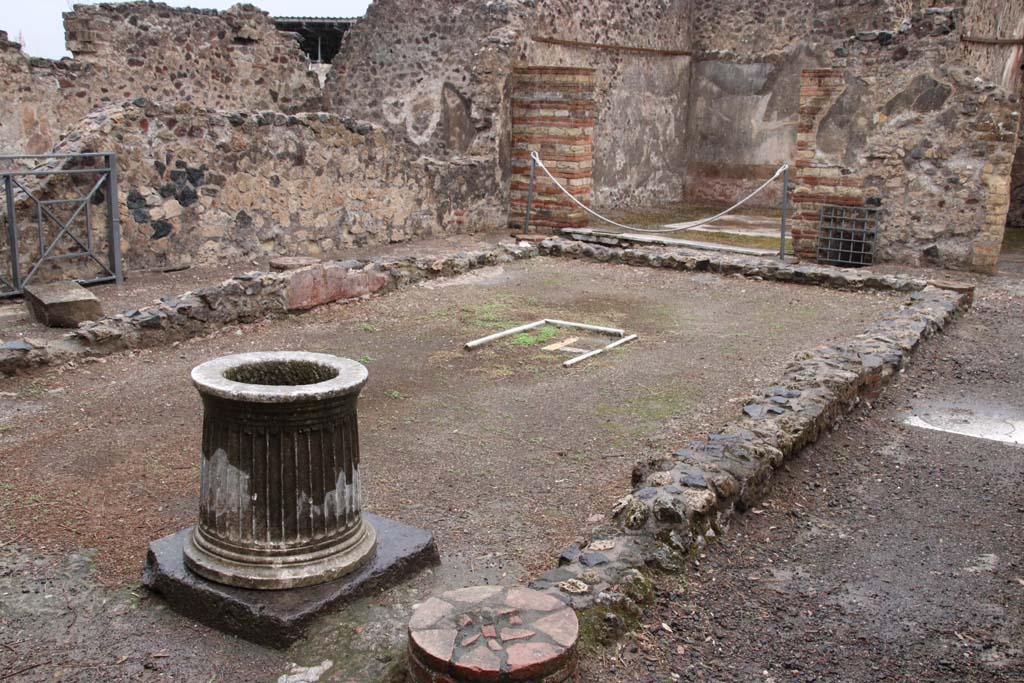
VIII.6.10 Pompeii. October 2020. Looking north-east across
peristyle area towards room “p”. Photo courtesy of Klaus Heese.
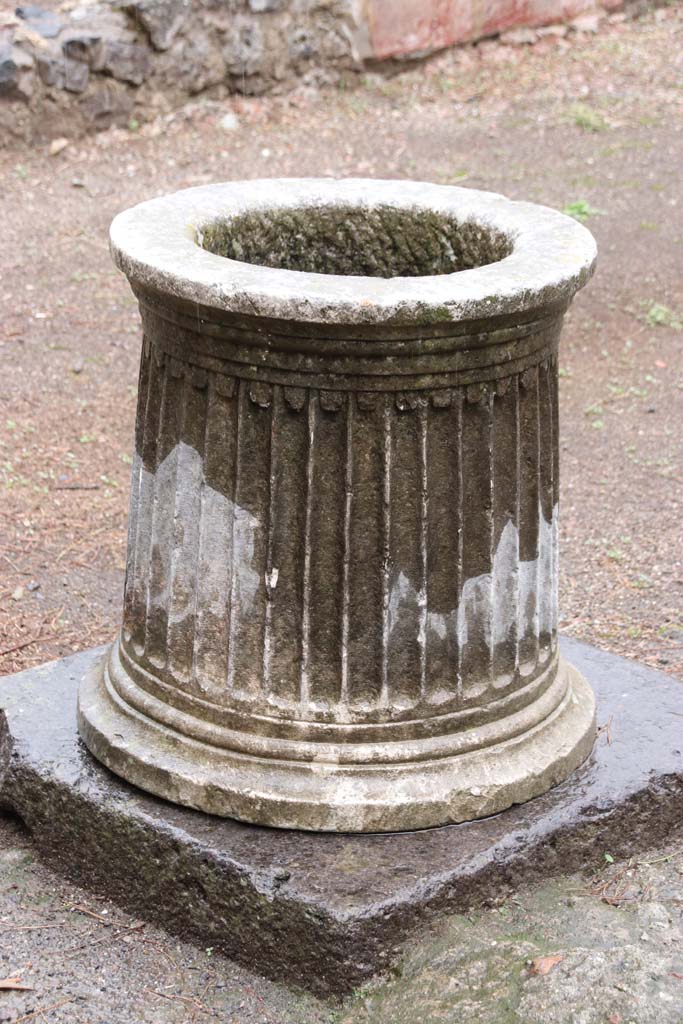
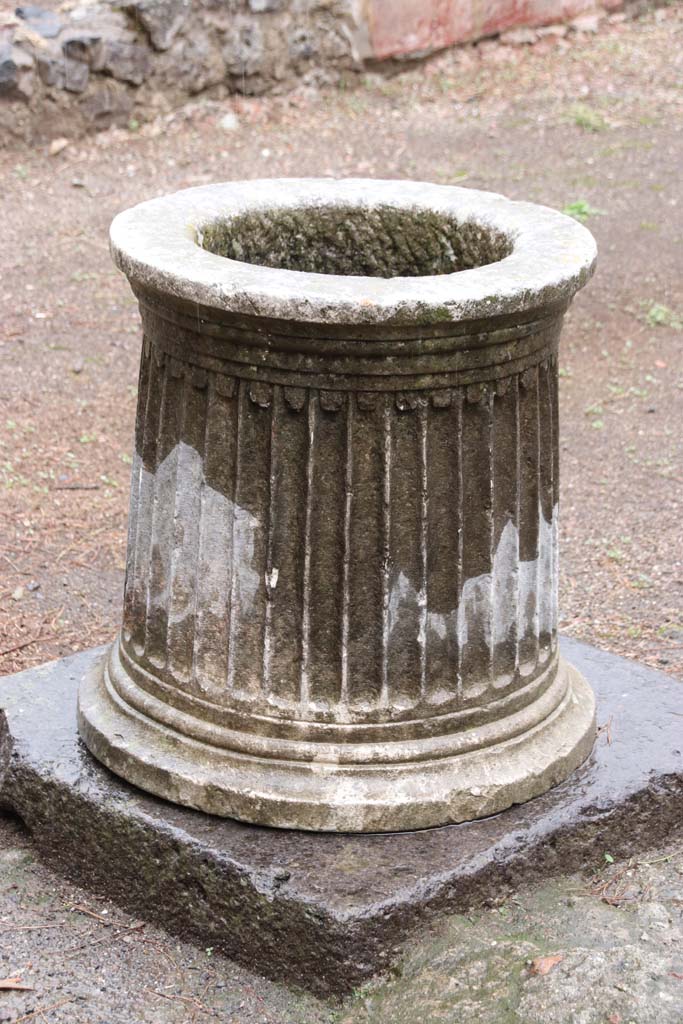
VIII.6.10 Pompeii. October 2020. Puteal in peristyle area.
Photo courtesy of Klaus Heese.
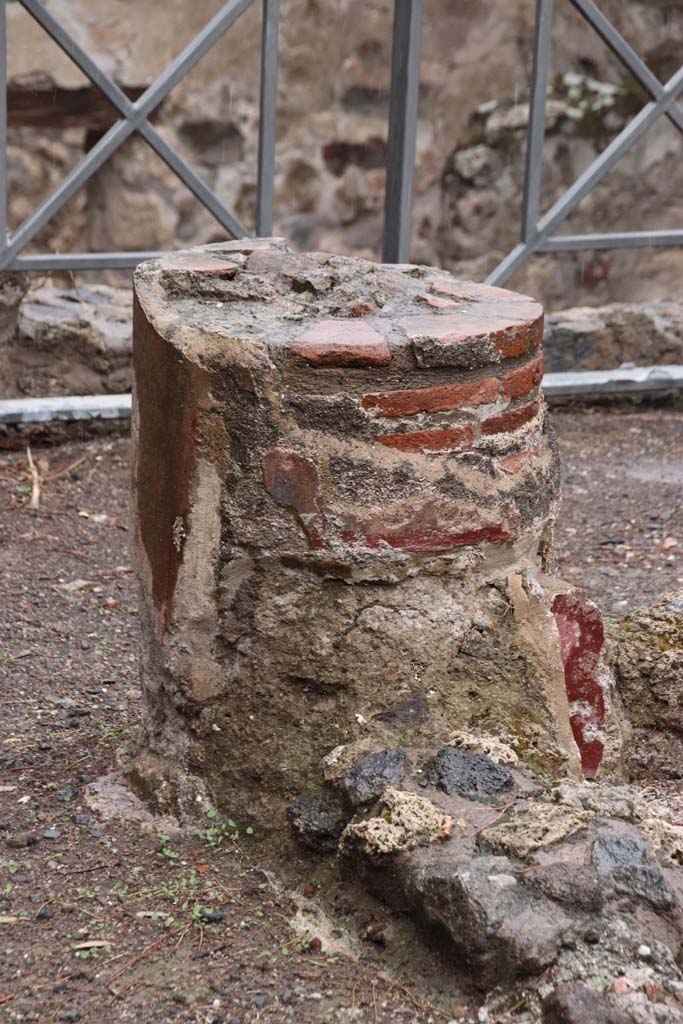
VIII.6.10 Pompeii. October 2020. Column in peristyle area.
Photo courtesy of Klaus Heese.
VIII.6.1.8.9.10.11 combined plans