VII .10.3 Pompeii. Casa della Caccia nuova. House
of Florillus?
Linked to VII .10.14 in the
past but doorway now blocked.
Excavated 1821 and 1863. (Vico
d’Eumachia 9).
According to
Pagano –Nuova casa della caccia –
“A destra del
protiro trovasi la cella del portinaio.
L’atrio ha il
solito impluvio, ed il pavimento era di musaico bianco. Le pareti sono molto
ben colorite, ed in giro sono di versi cubiculi anche ben dipinti.
Di fronte era il
tablino ove vedesi un bel quadretto figurante Arianna addormentata e Bacco, che
sollevando il velo che la ricopre, ne ammira le belle fattezze. A destra del
nume evvi un piccolo Satiro in atto di sorpresa. Nel fondo vedesi il vecchio
Sileno e due Baccanti.
Il peristilio era
circondato da colonnato che reggeva un portico coverto, le cui mura sono
dipinte in nero con riquadri gialli e rossi, e finiscono nella parte inferiore
con un podio rosso. Il muro a sinistra offre un bellissimo dipinto esprimente
una caccia di animali, ove vedesi un orso al naturale che si avventa ad un
cinghiale, ed in distanza un leone in atto di saltare una rupe che giunge in
aiuto dell’orso.
Nell’ altra
parete di fronte sono altri animali, cioe un leone coricato, una cerva in
cammino, ed in distanza un tigre che fugge.
In prosieguo
trovasi la sala da pranzo, triclinio, con larga finestra sporgente nel
giardino, e sullo stesso lato sta un quadretto che rappresenta a mezzo busto un
Bacco al naturale coronato di foglie e cogli occhi in estasi, ed altra figura
vedesi alle sue spalle, forse Venere.”
See Pagano, N. (1868). Guida di Pompei. 2nd ed. (p.22-23)
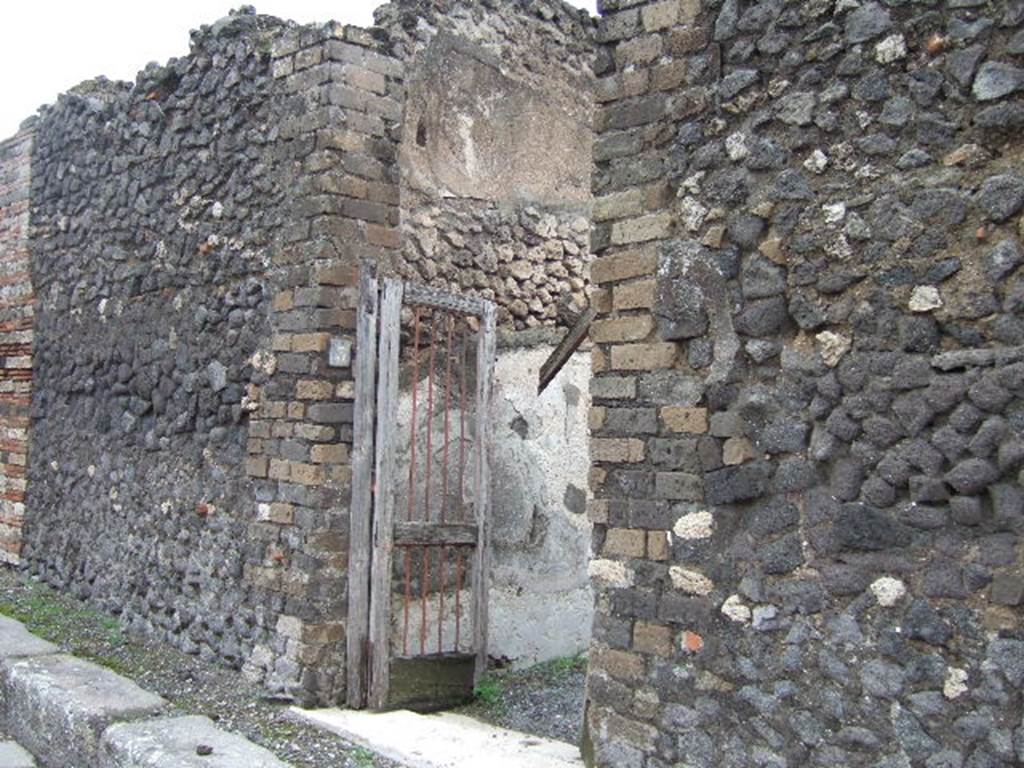
VII.10.3 Pompeii. December 2005. Entrance doorway, with roughly hewn white travertine threshold.
The socket for the housing of the hinges and for the fixing of the battens for the closure of the double doors could be seen.
See Studi della
Soprintendenza archeologica di Pompei, 22: L’insula
VII, 10 di Pompei, by Angelo Amoroso. (p.53)
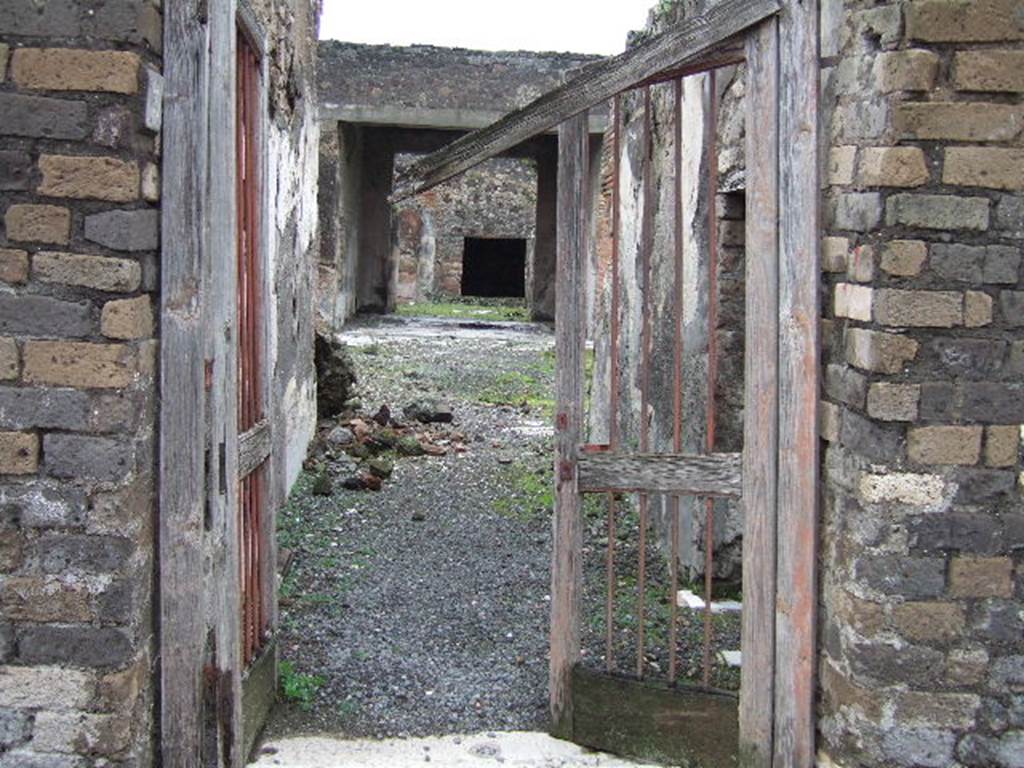
VII.10.3 Pompeii. December 2005. Looking east from entrance, through entrance fauces or corridor, 1.
The doorway to the cella ostiaria (room 2) opened in the south-west (on the right).
The entrance corridor was found with a floor of simple cocciopesto. The walls were covered with white plaster.
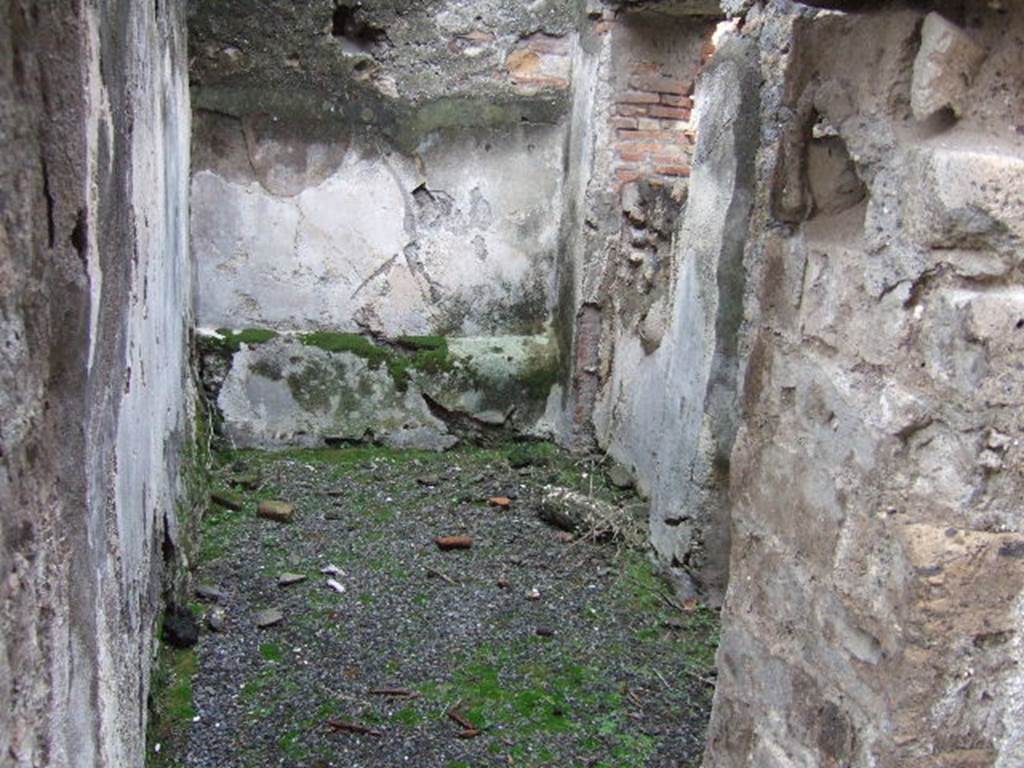
VII.10.3 Pompeii. December 2005.
Room 2, the cella ostiaria on south side of entrance, with a doorway (now blocked) which gave direct access to Vicolo di Eumachia.
The floor, originally, would have been formed of cocciopesto. (p.54)
The threshold of the doorway was composed of three slabs,
grey marble, white marble and travertine. (p.73)
See Studi della
Soprintendenza archeologica di Pompei, 22: L’insula
VII, 10 di Pompei, by Angelo Amoroso.
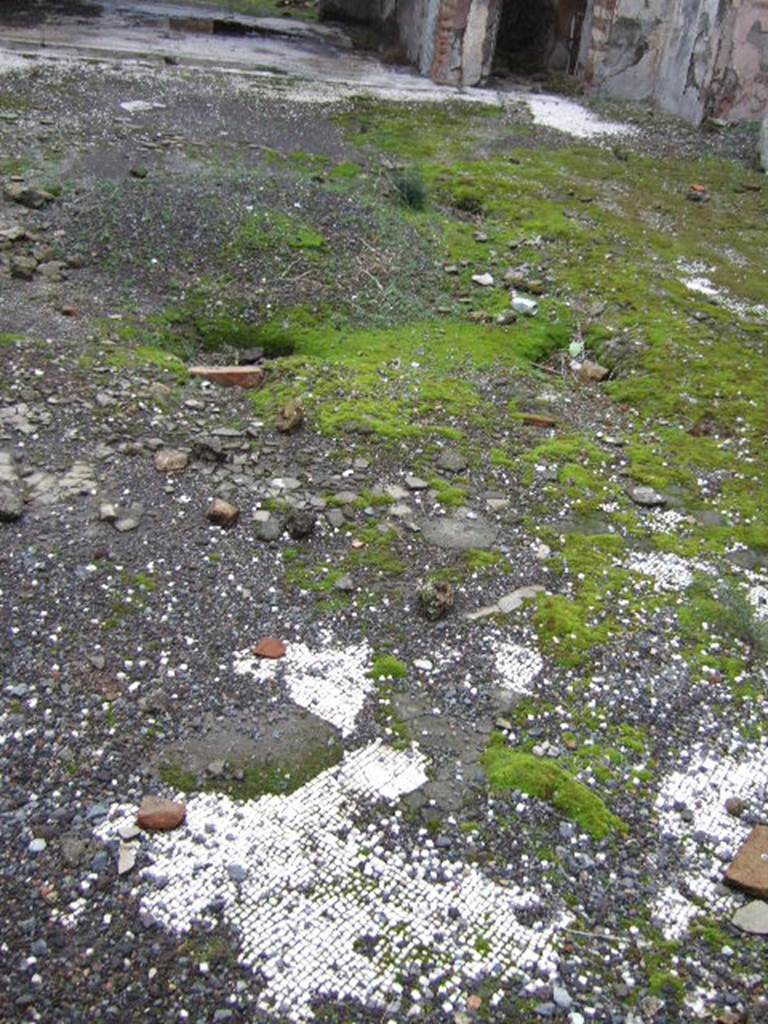
VII.10.3 Pompeii. December 2005. Atrium 3, with remains of impluvium and mosaic floor.
According to Amoroso, the impluvium was not in line with the entrance doorway. (p.44)
Originally the floor would have been in cocciopesto, but when the house was redecorated the atrium was given a new mosaic floor.
The floor was composed of white tesserae with a border of two strips of three lines of black tesserae.
(p.73)
Many of the rooms would have had a simple floor of cocciopesto, however, it should not be forgotten that certain rooms would have had floors and wall decorations of some merit and of these, now there is little visible trace. (p.59)
The walls of the atrium would have been seen with a rich decoration of painted final IVth-style plaster.
There would have been a high zoccolo (plinth/dado) composed of figurative panels on a white background, separated by yellow-ochre colour painted strips.
The central area of the walls had a white background, subdivided into wide red and yellow panels, separated by a border.
With regard to the zoccolo/plinth of the north wall, small square painted panels were documented.
The decoration of the base of the south wall showed similar motifs to those on the opposite wall.
A trace of a black dove was still visible on the top of the south-east
zoccolo. (p.73)
See Studi della
Soprintendenza archeologica di Pompei, 22: L’insula
VII, 10 di Pompei, by Angelo Amoroso, (p.44,59,73)
According to Breton, the paintings from the atrium walls were almost all gone, but on the base of the walls it was still possible to see vases, a red partridge, some lions chasing bulls, dogs chasing a wild boar and a dog watching sheep.
Several rooms around the atrium were fairly well decorated.
See Breton, Ernest. 1870. Pompeia, Guide de visite a Pompei, 3rd ed. Paris, Guerin.
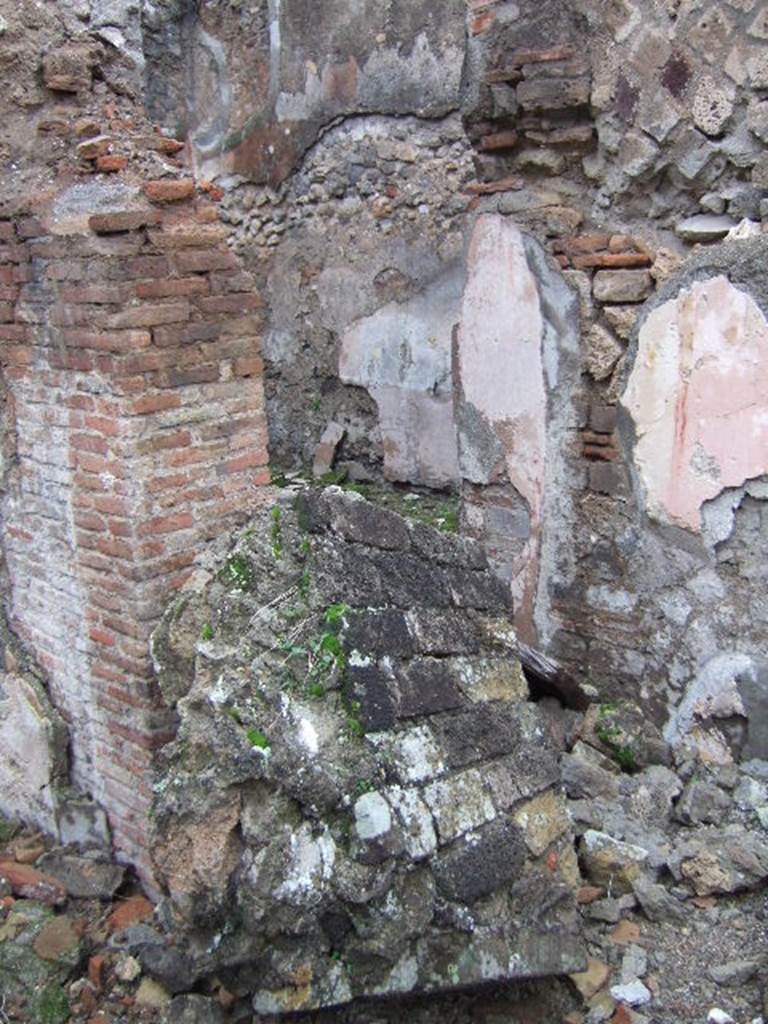
VII.10.3 Pompeii. December 2005. Doorway to room 4, in north-west corner of atrium.
The doorway would have led into a room, described as a triclinium, originally with flooring of a reddish cocciopesto.
The door threshold was formed by two square slabs of travertine and inserted in its south end was a small slab of grey marble.
Seen on each of the smooth surface of the slabs, was a circular recess for the fixing of the double-door hinges. (p.54)
The floor was then upgraded to a black and white mosaic.
The walls were redecorated in the fourth style.
The black zoccolo (dado/plinth) showed alternative narrow panels with rosettes, in the centre were plants motifs.
The middle zone on each wall showed an aedicula panel, painted white which contained a pinax, no longer visible.
The side panels were painted red, edged by a simple bordered band.
See Studi della
Soprintendenza archeologica di Pompei, 22: L’insula
VII, 10 di Pompei, by Angelo Amoroso, (p.54 and p.74)
According to Bragantini, the mosaic was visible on the north-east side, whilst on the south-east side the cocciopesto was visible.
See Bragantini, de Vos, Badoni, 1986. Pitture e Pavimenti di Pompei, Parte 3. Rome: ICCD. (p.179)
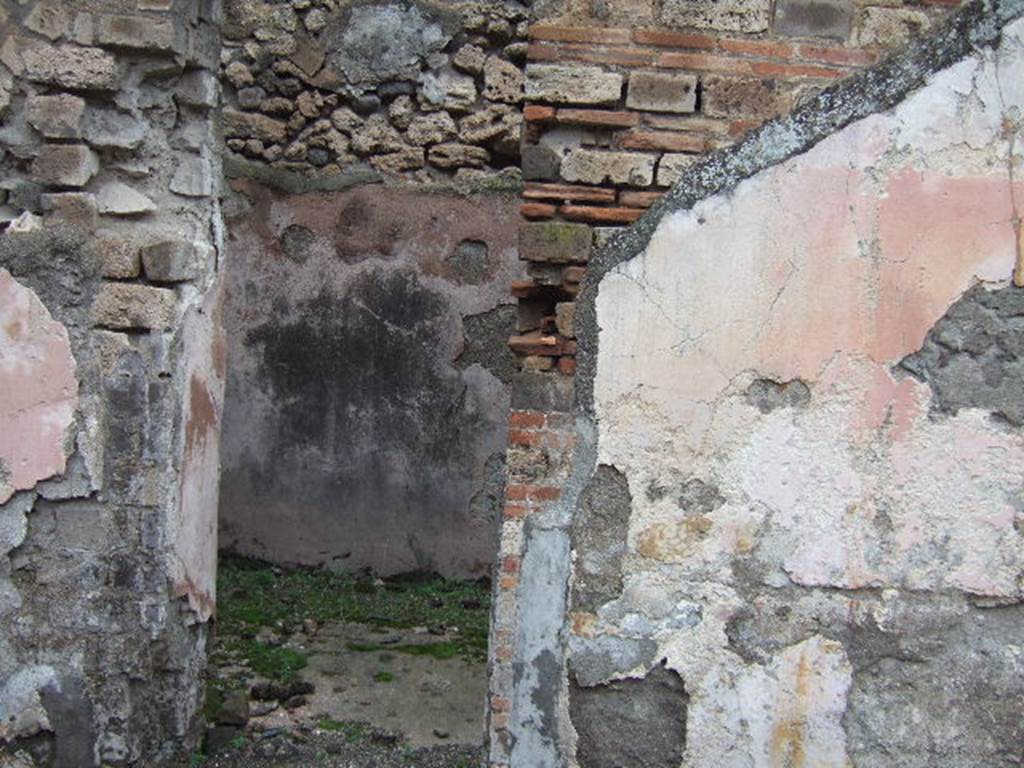
VII.10.3 Pompeii. December 2005. Doorway to room 5, a cubiculum on north side of atrium.
This room had a floor of red cocciopesto.
The door threshold formed of two rectangular travertine slabs, was also marked in the centre with a circular recess for the fixing of the double-door hinges.
When redecorated this room was repainted with red plaster
walls, of which some traces remain. Its original flooring was kept.
See Studi della
Soprintendenza archeologica di Pompei, 22: L’insula
VII, 10 di Pompei, by Angelo Amoroso, (p.54 and p.74)
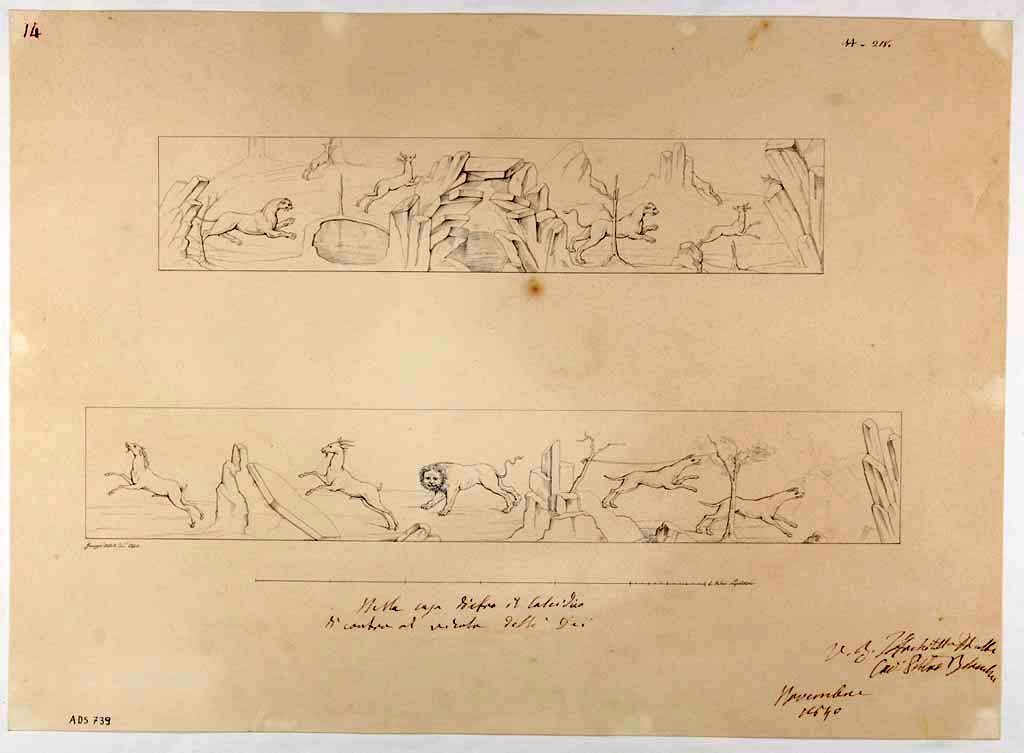
VII.10.3 Pompeii. Drawing by Giuseppe Abbate, 1840, of copy of paintings seen on zoccolo in atrium showing hunt of the wild beasts.
Now in Naples Archaeological Museum. Inventory number ADS 739.
Photo © ICCD. https://www.catalogo.beniculturali.it/
Utilizzabili alle
condizioni della licenza Attribuzione - Non commerciale - Condividi
allo stesso modo 2.5 Italia (CC BY-NC-SA 2.5 IT)
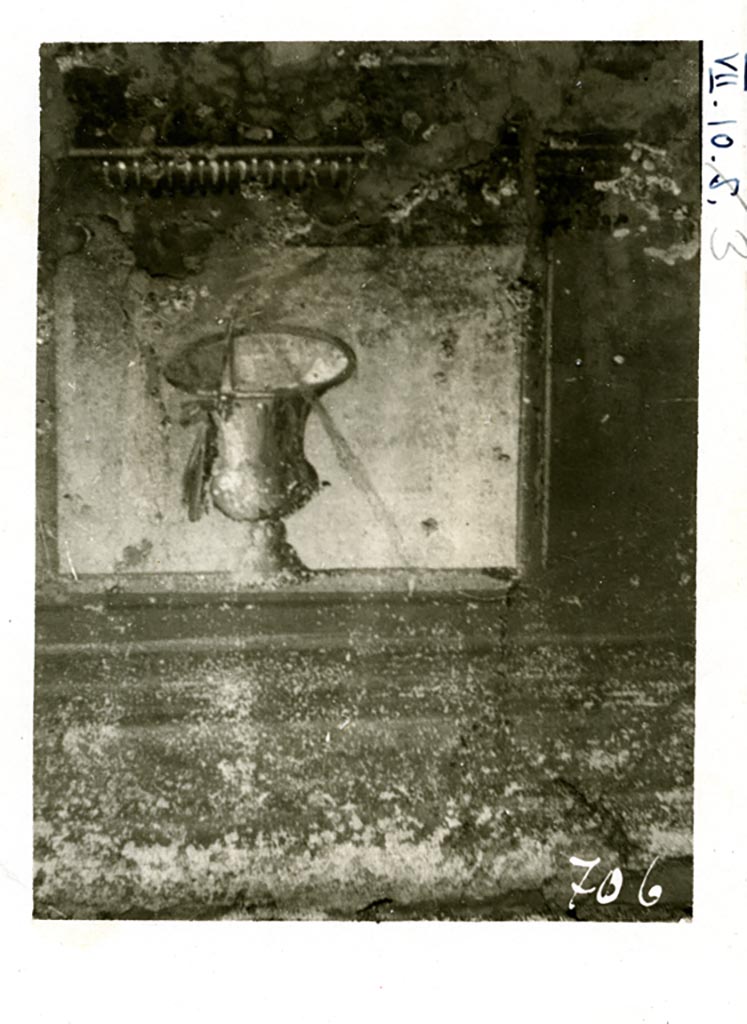
VII.10.3 Pompeii. Pre-1937-39. Atrium, painted panel of vase.
Photo courtesy of American Academy in Rome, Photographic Archive. Warsher collection no. 706.
According to PPM, this may have been from the west end of the north wall of the atrium painted on the yellow zoccolo.
See Carratelli, G. P., 1990-2003. Pompei: Pitture e Mosaici. Roma:
Istituto della enciclopedia italiana, (p.389, no.6).
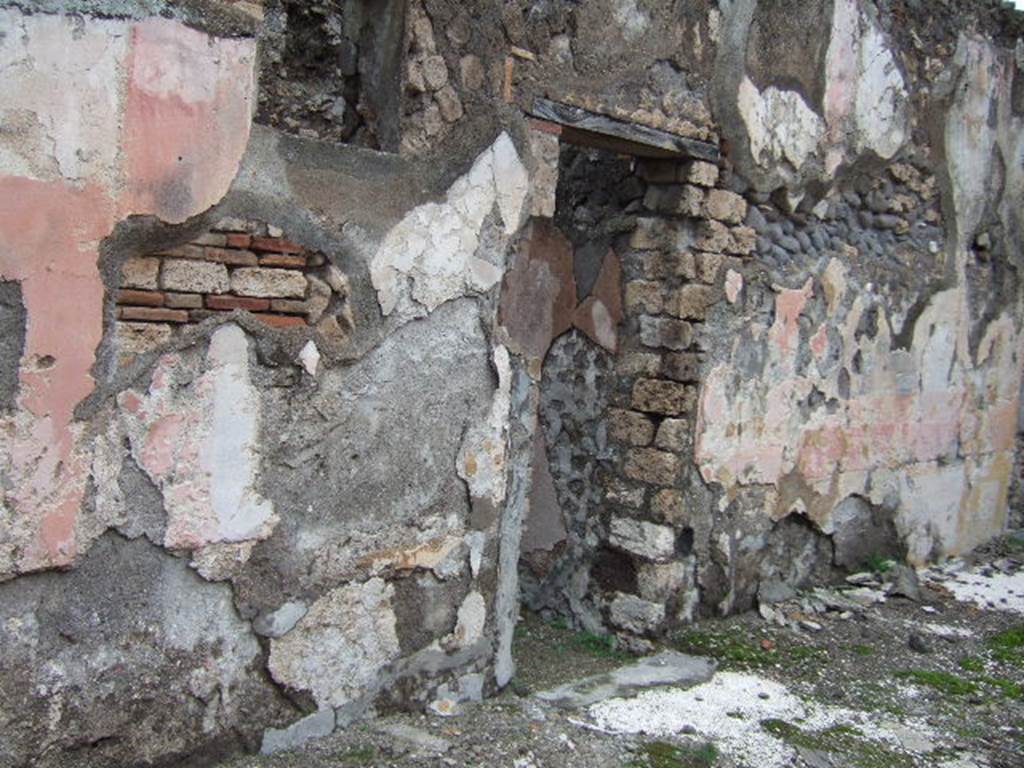
VII.10.3 Pompeii. December 2005. Doorway to room 6, a cubiculum on north side of atrium.
This room also had a floor of cocciopesto, joined in the doorway to the threshold which was formed by two rectangular travertine slabs, marked in the centre with a circular recess for the fixing of the double-door hinges.
When redecorated the walls were repainted with plaster panels edged with a red line, of which some traces remain.
The middle of the walls had vertical panels separated by architectural paintings, the central panels were yellow, the sides being red.
The zoccolo was painted with plant motifs on a red background.
The upper part of the walls was painted white. Its original flooring was retained.
See Studi della
Soprintendenza archeologica di Pompei, 22: L’insula
VII, 10 di Pompei, by Angelo Amoroso, (p.54 and p.74)
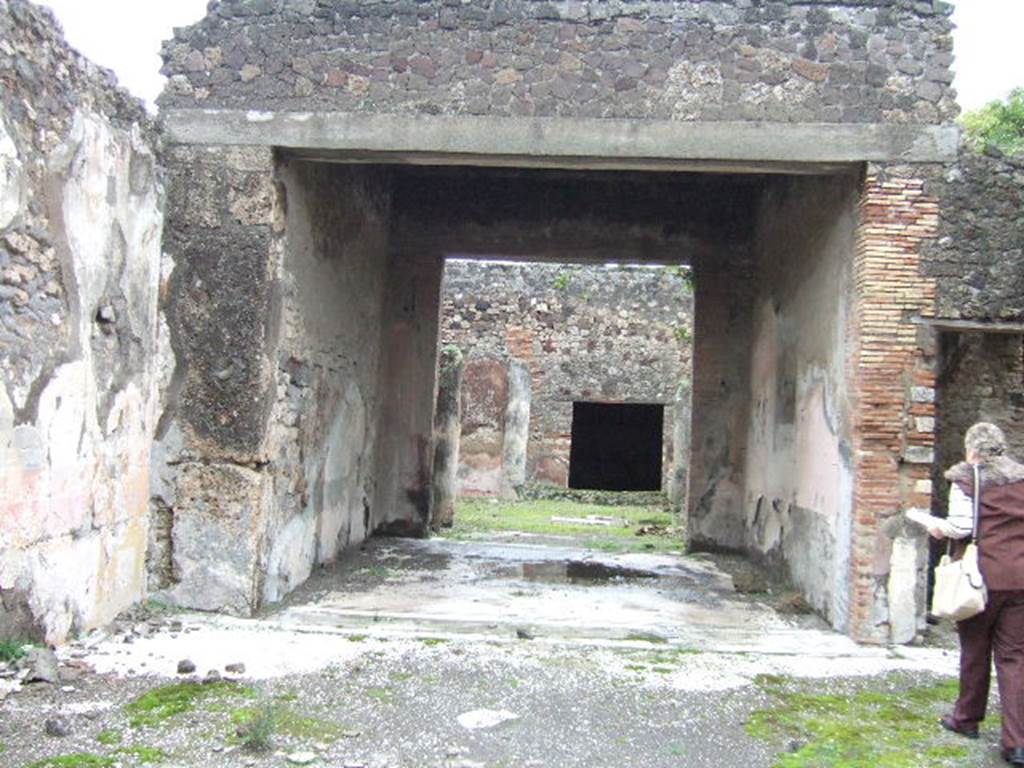
VII.10.3 Pompeii. December 2005. Room 7, looking east across tablinum, from atrium.
According to Breton, the tablinum was completely open onto the atrium and at the rear onto the peristyle.
The floor was mosaic. The wall painting on the right (south) wall was preserved.
In the red side panels of the south wall were paintings of two women holding masks.
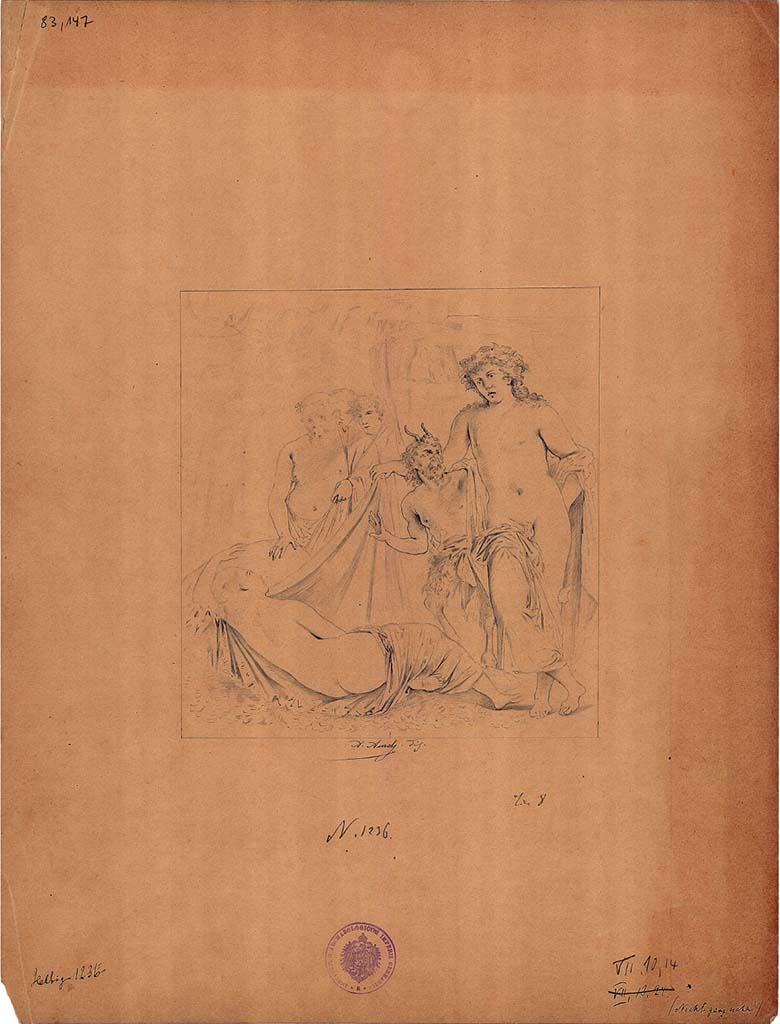
In the centre on a white panel was a painting of Bacchus finding sleeping Ariadne on the isle of Naxos.
The painting from the left (north wall) no longer existed.
See Breton,
Ernest. 1870. Pompeia, Guide de visite a
Pompei, 3rd ed. Paris,
Guerin.
See Helbig, W., 1868. Wandgemälde der vom Vesuv verschütteten Städte Campaniens. Leipzig: Breitkopf und Härtel. (874,881)
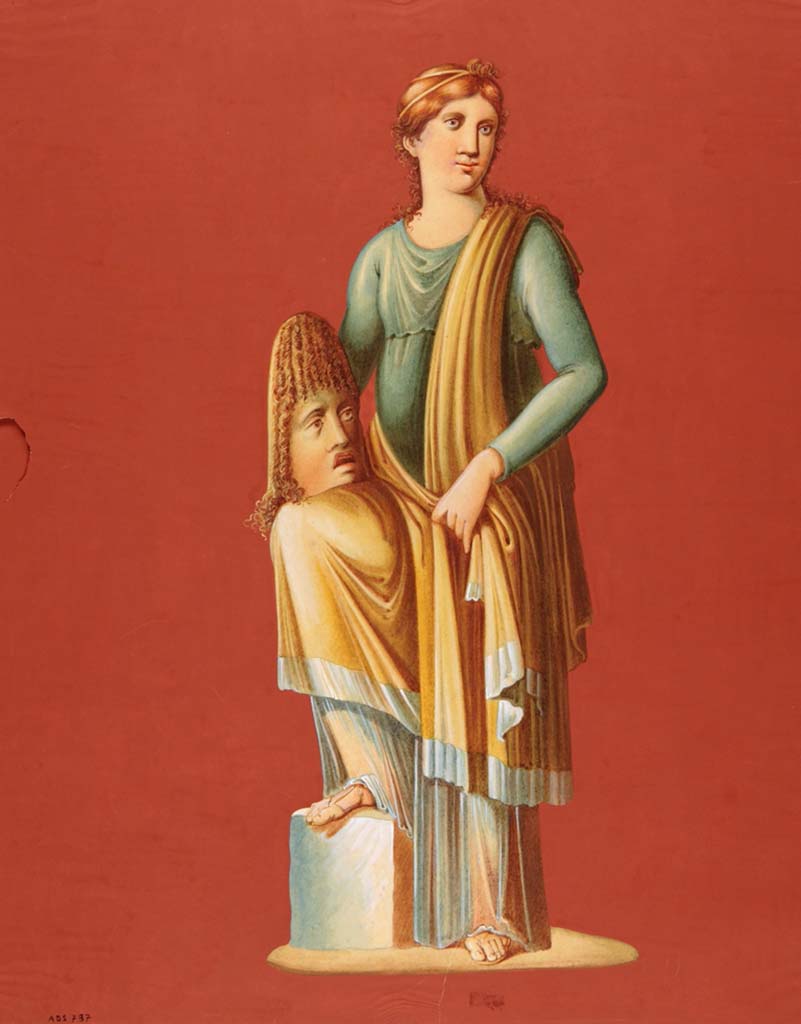
According to Amoroso, on the south wall the central panel had a blue background and in the red side panels were paintings of the muses, Melpomene (on the east end) and Thalia (on the west end).
When redecorated the tablinum received a new mosaic floor, with a motif in the centre separated by a double black line of mosaics.
At the atrium end (west end), the tablinum floor was
separated from the atrium floor by a mosaic of twining ivy plants and leaves
enclosed by black lines on the white background. (see fig 35b, on p.107) (p.75)
See Studi della
Soprintendenza archeologica di Pompei, 22: L’insula
VII, 10 di Pompei, by Angelo Amoroso, (p.75, figs 16,1 and 16,2)

VII.10.3 Pompeii. Room 7, tablinum, centre of south wall. Wall
painting of Dionysus finding Ariadne.
Now in Naples Archaeological Museum. Inventory number
111484.
Our thanks to Rachel Lowder for helping with this.
VII.10.3 Pompeii. Old photo of 1880. Room 7, tablinum, centre of south wall. Wall painting of Dionysus finding Ariadne.
Now in Naples Archaeological Museum. Inventory number 111484.
See Schefold, K., 1962.
Vergessenes Pompeji.
Bern: Francke. (p.142,166 and photo 167,2).
Kuivalainen describes –
“A composition of six figures. In the left foreground a sleeping female callipyge is reclining on a green pillow to the left. A tall youth on the right stands with his weight on his left leg; his purple cloak covers his right thigh, goes round his waist and up to his left forearm; his brownish curly hair is decorated with a wreath; he looks down at the female intensively, lifting her yellow cloak with a red lining with his right hand. On his right side stands a small faun with hoofs, wearing a loincloth; his hair is short and curly with long horns pointing backwards; he points with his hand at the sleeping woman and watches the youth, Behind, on the left, stands Silenus wearing a red cloak, and holding a stick or a thyrsus in his left hand. Behind him are the heads of two more figures. In the upper background a rocky seascape with a ship in full sail.”
Kuivalainen comments -
“A tight composition on the seashore, with a limited amount of companions, and now without Hypnus.”
See Kuivalainen, I., 2021. The Portrayal of Pompeian Bacchus. Commentationes Humanarum Litterarum 140. Helsinki: Finnish Society of Sciences and Letters, p.150, E12.
VII.10.3 Pompeii but described as from VII.10.14.
Room 7, tablinum.
Drawing by A. Aurelj of painting from centre of south wall showing
Dionysius finding Ariadne.
DAIR 83.147. Photo
© Deutsches Archäologisches Institut, Abteilung Rom, Arkiv.
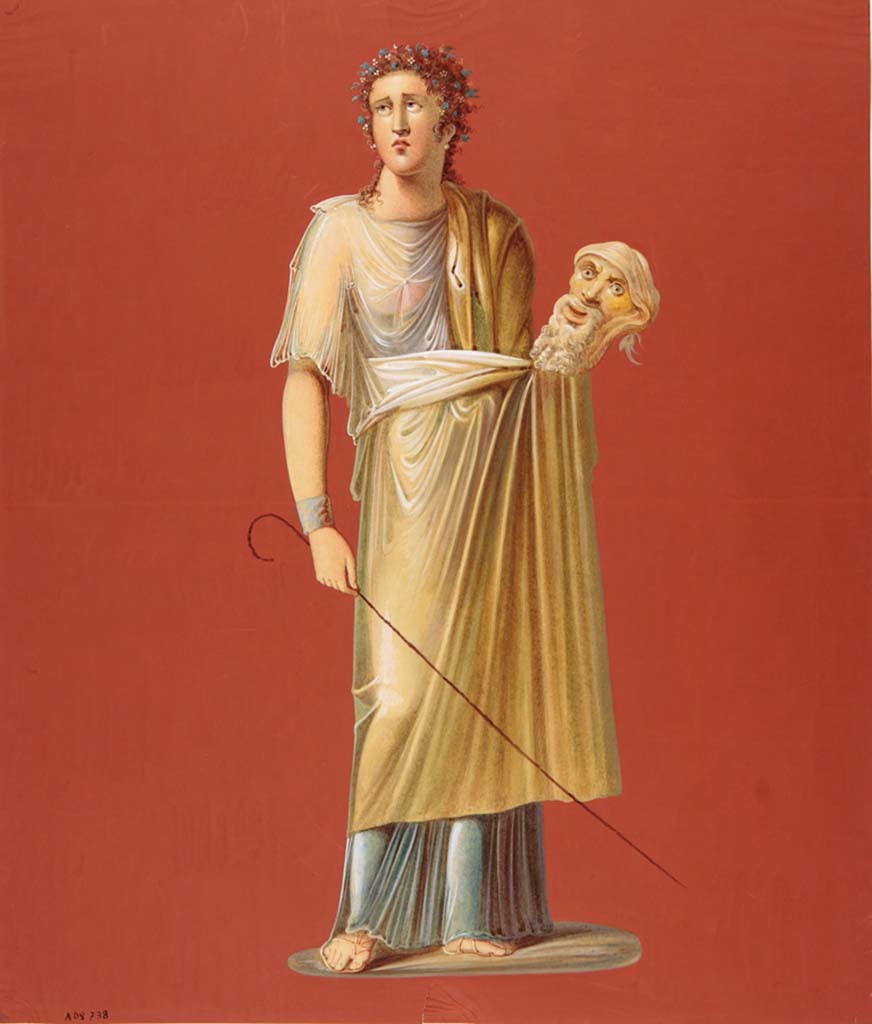
VII.10.3 Pompeii. Anonymous painting of Melpomene, from the east end of the south wall of tablinum.
See Helbig, W.,
1868. Wandgemälde der vom Vesuv verschütteten Städte Campaniens. Leipzig: Breitkopf und Härtel. (874).
Now in Naples
Archaeological Museum. Inventory number ADS 737.
Photo © ICCD. https://www.catalogo.beniculturali.it/
Utilizzabili alle
condizioni della licenza Attribuzione - Non commerciale - Condividi
allo stesso modo 2.5 Italia (CC BY-NC-SA 2.5 IT)

VII.10.3 Pompeii. Anonymous painting of Thalia on the west end of the south wall of tablinum.
See Helbig, W.,
1868. Wandgemälde der vom Vesuv verschütteten Städte Campaniens. Leipzig: Breitkopf und Härtel. (881).
Now in Naples
Archaeological Museum. Inventory number ADS 738.
Photo © ICCD. https://www.catalogo.beniculturali.it/
Utilizzabili alle condizioni della licenza Attribuzione
- Non commerciale - Condividi allo stesso modo 2.5 Italia (CC BY-NC-SA 2.5 IT)

VII.10.3 Pompeii. December 2005.
South-east corner of atrium with doorway to corridor 8 next to tablinum, and doorways to rooms 9 and 10 on south side of atrium.
According to Breton, on the right of the tablinum was a corridor leading to a kitchen where a big iron bucket attached to a wall and the pipe used to fill it up, could still be seen. On the right was a painting of a woman holding a wand.
See Breton, Ernest. 1870. Pompeia, Guide de visite a Pompei, 3rd ed. Paris, Guerin.
According to Boyce, the woman held a rudder.
See Boyce G. K., 1937. Corpus of the Lararia of Pompeii. Rome: MAAR 14. (p.69, no.308)

VII.10.3 Pompeii. December 2005.
Looking south through doorway of room 9 towards doorway of room 22, possibly a small storeroom, on right.
Looking south across room 9, a triclinium which originally had a floor of cocciopesto.
According to Amoroso, the walls of room 9 were recovered with painted plaster made of wide red and yellow sections, separated by white panels.
The zoccolo was painted with plant motifs.
See Studi della
Soprintendenza archeologica di Pompei, 22: L’insula
VII, 10 di Pompei, by Angelo Amoroso. (p.74)

VII.10.3 Pompeii. December 2005. Doorways to rooms 10 and 11, cubicula on south side of atrium.
Both of these rooms also had flooring of red cocciopesto.
The doorway, on the left, had a threshold formed by two rectangular limestone slabs, marked in the centre with a circular recess for the closing fixing for the double-set of doors.
See Studi della
Soprintendenza archeologica di Pompei, 22: L’insula
VII, 10 di Pompei, by Angelo Amoroso. (p.55)

VII.10.3 Pompeii. December 2005. Room 10, looking south.
According to Amoroso, the tops of the walls were painted with plaster in two horizontal bands.
The middle section of each wall was separated into three vertical panels edged with a border. The central area was white, and the two sides panels were yellow. The zoccolo was red with plant motifs painted on it.
Found painted on the walls of this room were vignettes showing sirens hovering in the air on monochrome green and yellow background.
They held the plate and crook.
See Studi della
Soprintendenza archeologica di Pompei, 22: L’insula
VII, 10 di Pompei, by Angelo Amoroso. (p.74)
See Helbig, W., 1868. Wandgemälde der vom Vesuv verschütteten Städte Campaniens. Leipzig: Breitkopf und Härtel. (899)

VII.10.3 Pompeii. December 2005. Room 11, looking south.
According to Amoroso, originally this room would have been connected to the rear room of VII.10.2 by a doorway in the south wall.
This was then blocked off, bricked up and re-plastered.
See Studi della
Soprintendenza archeologica di Pompei, 22: L’insula
VII, 10 di Pompei, by Angelo Amoroso. (p.74)

VII.10.3 Pompeii. December 2005. Doorway to room 12, on west side of atrium.
According to Amoroso, this may have been a cubiculum, or even a small oecus. (p.58)
The floor of this room was formed of mosaic, with white tesserae and probably a border of black tesserae.
The threshold was made from a square, formed by black mosaic lines between which was embedded a black diamond shape on a white background.
The walls were renovated with Fourth style paintings, the
dark zoccolo showed red divisions, in which were painted plants.
The middle zone of each wall showed red and yellow vertical panels.
In the central panel was a painting of the attributes of a divinity, the side panels showed pinakes with landscape paintings.
The top of the walls had a white stucco cornice, preserved only in the south-west corner.
The attributes of Diana, now faded and lost, were shown in a
painting on the north wall, and objects sacred to Dionysius were painted on the
west wall. (p.74)
See Studi della Soprintendenza archeologica di Pompei, 22: L’insula VII, 10 di Pompei, by Angelo Amoroso. (p.58 and p.74)
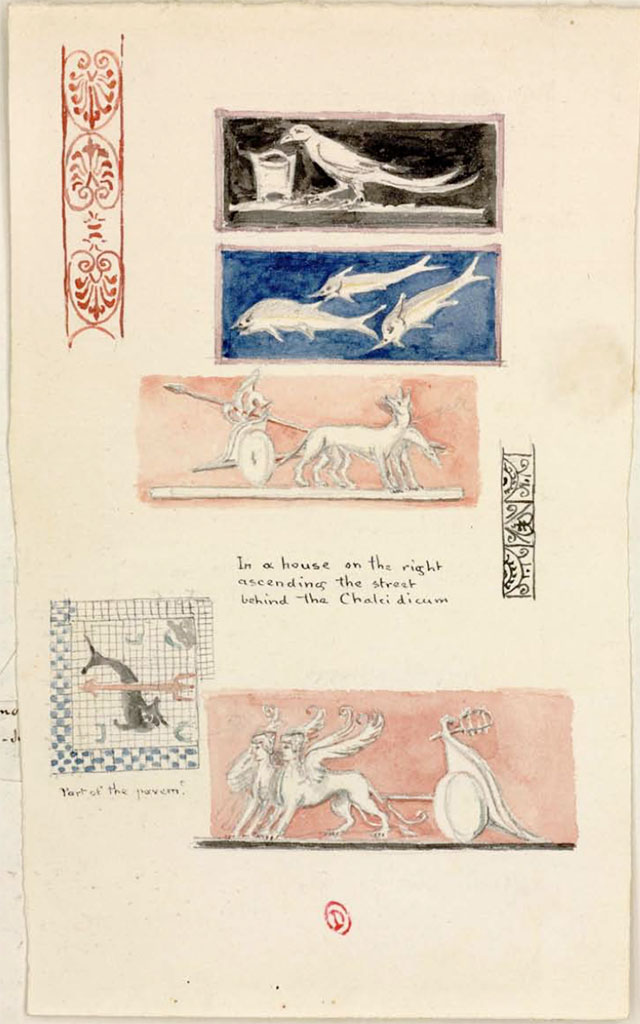
According to Helbig, this room contained paintings of two chariots.
See Helbig, W., 1868. Wandgemälde der vom Vesuv verschütteten Städte Campaniens. Leipzig: Breitkopf und Härtel. (246, 596)

VII.10.3 Pompeii. December 2005. Room 12, mosaic floor and marble door supports in door threshold.
VII.10.3 Pompeii. December 2005. Room 12, south-west corner.
According to Fiorelli, seen on the walls in this small cubiculum, in addition to a scene with landscapes, were a painted chariot pulled by deer, and thyrsus in a chariot pulled by panthers.
See Pappalardo,
U., 2001. La Descrizione di Pompei per
Giuseppe Fiorelli (1875). Napoli: Massa Editore. (p.108)
See Fiorelli Descrizione di Pompei, 1875, (p.273-276)
![VII.10.3 Pompeii. Painted between 1819 and 1832 by William Gell, described as “In a house on the right ascending the street behind the Chalcidicum”.
In our room 12, Fiorelli identified two paintings of chariots.
See Gell, W. Pompeii unpublished [Dessins de l'édition de 1832 donnant le résultat des fouilles post 1819 (?)] vol II, pl. 91v.
Bibliothèque de l'Institut National d'Histoire de l'Art, collections Jacques Doucet, Identifiant numérique Num MS180 (2).
See book in INHA Use Etalab Licence Ouverte](7%2010%2003%20p1_files/image042.jpg)
VII.10.3 Pompeii. Painted between
1819 and 1832 by William Gell, described as “In a house on the right ascending the street behind the
Chalcidicum”.
In our
room 12, Fiorelli identified two paintings of chariots.
See Gell, W. Pompeii unpublished [Dessins de
l'édition de 1832 donnant le résultat des fouilles post 1819 (?)] vol II, pl.
91v.
Bibliothèque de l'Institut National d'Histoire de
l'Art, collections Jacques Doucet, Identifiant numérique Num MS180 (2).
See book in INHA Use Etalab Licence Ouverte

See
Charles-Auguste Questel (1807-1888) Voyage en Italie et Sicile. Août 1831 -
novembre 1832, pl. 110/120.
INHA identifiant numérique : NUM MS 512. Document placé sous « Licence Ouverte / Open Licence » Etalab
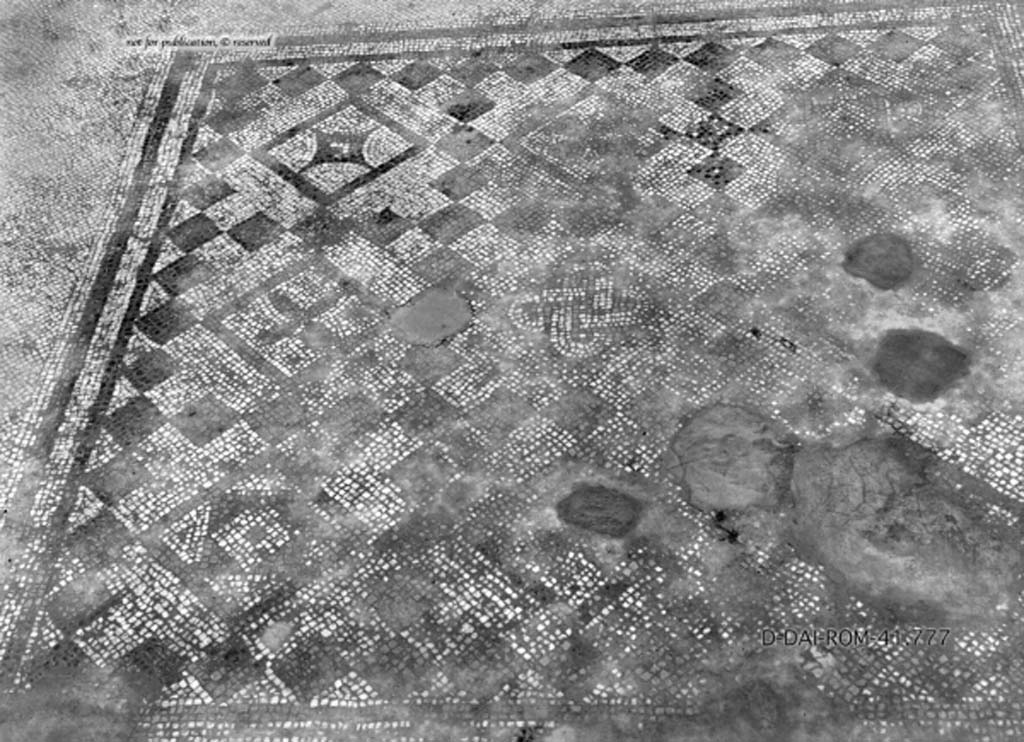
VII.10.3 Pompeii. December 2005. Looking east across mosaic floor with central motif in tablinum, room 7, towards garden.

VII.10.3 Pompeii. c.1930. Tablinum, detail of central mosaic.
DAIR 41.777. Photo © Deutsches
Archäologisches Institut, Abteilung Rom, Arkiv.
See Pernice, E. 1938. Pavimente und Figürliche Mosaiken:
Die Hellenistische Kunst in Pompeji, Band VI. Berlin: de Gruyter, (tav.
49.5, above.)

VII.10.3 Pompeii. December 2005. Looking east from tablinum into garden room 13.
According to Jashemski, the garden at the rear of the tablinum, excavated in 1863, was enclosed by a portico on the west, south and east sides.
The portico was supported by five white, fluted, stuccoed columns.
There was an engaged column at the north-west corner.
A low wall joined the columns, leaving an entrance to the garden opposite the wide entrance from the tablinum.
At the south end of the garden was a small pool with a hole in the centre for a fountain jet.
There was a gutter around the edges of the garden.
On the north wall was a large animal painting, but nothing now remains of this painting except the wide red border.
There was a good view of the garden from the exedra at the rear.
See Jashemski, W. F., 1993. The Gardens of Pompeii, Volume II: Appendices. New York: Caratzas. (p.191)

VII.10.3 Pompeii. December 2005. North wall and north-east corner of garden room 13.
According to Jashemski, on this wall was the large animal painting, but nothing now remains of this painting except the wide red border.
According to Helbig, on the left, painted in its natural size, was a boar expecting an attack from a bear moving towards it.
On the right a lion lay behind a rock, his expression grim as if his peace had been disturbed.
In front lay another lion with its mouth half open, and in front of him stood a deer with front paw poised ready for flight.
In the background a leopard pursued a gazelle.
See Helbig, W., 1868. Wandgemälde der vom Vesuv verschütteten Städte Campaniens. Leipzig: Breitkopf und Härtel. 1583, 1584.

VII.10.3 Pompeii. December 2005. Looking towards east side, and columns of portico joined by a low wall, of garden room 13.
(At the rear, the square doorway to the exedra can be seen in the photo above.)
According to Amoroso, at the rear of the atrium is a small internal courtyard or peristyle, reached by passing through the tablinum.
Three rooms were on the east side of the peristyle, two of them opened onto it.
He describes “our room 14” as a large exedra, and on its north side were two cubiculi (“our rooms 15 and 16”) in which was preserved a rich IVth style wall decoration.
Studi della
Soprintendenza archeologica di Pompei, 22: L’insula
VII, 10 di Pompei, by Angelo Amoroso, (p.55)
According to Breton, the low wall (pluteus) joining the columns was painted a very bright red.
At the rear, east side, of the peristyle were two rooms.
In the north wall of the exedra was a small back door that led into a very small room that seemed to have served as an anteroom for a well decorated room that had a second entrance onto the peristyle.
See Breton, Ernest. 1870. Pompeia, Guide de visite a Pompei, 3rd ed. Paris, Guerin.

VII.10.3 Pompeii. December 2005. Garden room 13, small marble fountain pool on south side of garden.

VII.10.3 Pompeii. December 2005. Room 14, east wall of exedra/oecus, at rear of peristyle garden.
According to Fiorelli, two paintings were found in the exedra.
One represented the head of Dionysus crowned with ivy leaves, with his head beside a Bacchante appearing near his shoulder.
The other was circular showing Perseus holding up the head of Medusa, to show the reflection in the water to Andromeda, who rested on his shoulder.
On one side of the exedra are two other rooms, of which the second was used perhaps for a dormitory
See Pappalardo, U., 2001. La Descrizione di Pompei per Giuseppe Fiorelli (1875). Napoli: Massa Editore. (p.108)
According to Bragantini, the floor was black and white mosaic.
In the centre was an emblema of opus sectile showing squares and triangles in coloured marbles.
The walls were painted in the IVth style with a black zoccolo containing panels showing painted plants. The middle zone of the walls was red.
On the south wall, in the centre of the black zoccolo was a yellow panel with painted plants.
In the centre of the middle zone was a yellow panel with a painting, no longer recognisable.
See Bragantini, de Vos, Badoni, 1986. Pitture e Pavimenti di Pompei, Parte 3. Rome: ICCD. (p.177-8)
According to Richardson, found in the “triclinium” on the east side of the peristyle, were a painted bust of Bacchus and a maenad (Sommer negative 11918)
See Richardson, L., 2000. A Catalog of Identifiable Figure Painters of Ancient Pompeii, Herculaneum. Baltimore: John Hopkins. (p.127)
According to Helbig, found in the “triclinium” behind the peristyle was a painting of Perseus and Andromeda, (1198), and Bust of Dionysus, (385).
See Helbig, W., 1868. Wandgemälde der vom Vesuv verschütteten Städte Campaniens. Leipzig: Breitkopf und Härtel. (1198 and 385).
According to Amoroso, the exedra (our room 14) stood behind the viridarium and was decorated with a bacchic scene and with a pinax circolare, in which Perseus showing Andromeda the severed head of Medusa reflected in the water, could be seen.
Studi della
Soprintendenza archeologica di Pompei, 22: L’insula
VII, 10 di Pompei, by Angelo Amoroso, (p.274)

VII.10.3 Pompeii. December 2005.
Room 14, inlaid emblema in centre of exedra floor, of opus sectile showing squares and triangles in coloured marbles.
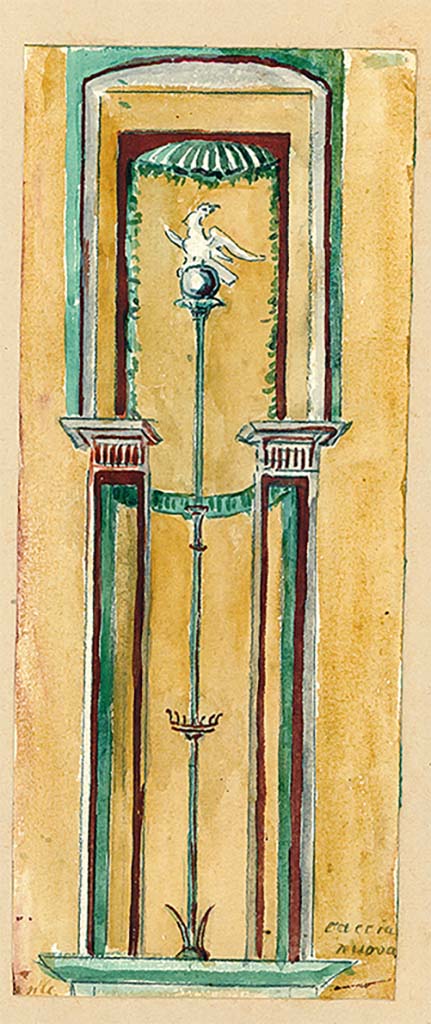
VII.10.3 Pompeii. December 2005. Room 15, cubiculum, looking towards east wall with doorway into room 16, cubiculum.
The doorway to room 14 is on the far right in room 16.
According to Breton, this was a well-decorated area, with a doorway from the peristyle, as well as one from the exedra, room 14.
According to Amoroso, this was repainted with new IVth style decorations.
The red zoccolo was divided into small partitions by black cornices and borders of yellow connected by small garlands.
In the centre was a painted stylized griffin.
The middle zone showed two red panels with black borders, separated by a yellow strip with architectural paintings, at the base of which was a predella edged with a red cornice in which a panther could be seen.
The second room, room 16, also had new fourth style decoration with black zoccolo, on which were painted vertical squares painted in white and yellow.
See Studi della
Soprintendenza archeologica di Pompei, 22: L’insula
VII, 10 di Pompei, by Angelo Amoroso, (p.77).

VII.10.3 Pompeii. Watercolour painting from north wall of
cubiculum, showing decoration.
DAIR 83.146. Photo ©
Deutsches Archäologisches Institut, Abteilung Rom, Arkiv.

VII.10.3 Pompeii. December 2005. Remains of painted plaster.

VII.10.3 Pompeii. December 2005.
Looking west from the exedra room 14, across the peristyle, through the tablinum, towards the house entrance.
The doorway leading to VII.10.14 is on the left.

VII.10.3 Pompeii. December 2005. Garden 13, south-west
corner of peristyle, with blocked doorway leading to
According to Jashemski, steps led from the peristyle to a large garden, which was excavated in 1863, with a separate entrance at number 14.
See Jashemski, W. F., 1993. The Gardens of Pompeii, Volume II: Appendices. New York: Caratzas. (p.191)
According to Amoroso, on the south-west side of the peristyle was the possible entrance to the large garden (see VII.10.14), which was characterised by the presence of a basin covered in cocciopesto (opus signinum) towards the extreme north-west corner, and with a lararium with an altar in front, in the south-east corner.
See Studi della
Soprintendenza archeologica di Pompei, 22: L’insula
VII, 10 di Pompei, by Angelo Amoroso, (p.29)
The doorway from the peristyle to corridor 8 leading to the atrium, can be seen on the right above.
A doorway to room 17 is on the left in the corridor, after the blocked doorway.
According to Fiorelli, this doorway led to wooden stairs that would have gone up to the upper rooms.
See Pappalardo, U., 2001. La Descrizione di Pompei per Giuseppe Fiorelli (1875). Napoli: Massa Editore. (p.108)
According to Amoroso, room 17 was possibly a small storeroom with a window in its east wall, which took light from the garden area.
It had two doorways, one north into the corridor that can be seen above, on the right.
The other doorway led west into another corridor leading south into the kitchen area.
On the south side of the kitchen area was the access to Vicolo degli Scheletri.
On the west of the kitchen was another room, room 22, which was possibly another small storeroom.
See Studi della
Soprintendenza archeologica di Pompei, 22: L’insula
VII, 10 di Pompei, by Angelo Amoroso, (p.55)

VII.10.3 Pompeii. December 2005. Corridor 18, looking south into room 19, the kitchen.
Directly ahead, in the south-west corner of the kitchen, was a small separate latrine.
According to Boyce, in the kitchen was a lararium painting upon a white background, depicting Fortuna.
In her left hand she held a rudder, her right hand extended above a globe which lay at her feet.
The painting was incomplete, for on the right side the stucco showed that at least one more figure was to have been added.
See Boyce G. K., 1937. Corpus of the Lararia of Pompeii. Rome: MAAR 14. (p.69, no.308)
See Helbig, W., 1868. Wandgemälde der vom Vesuv verschütteten Städte Campaniens. Leipzig: Breitkopf und Härtel. (74)
According to Amoroso, from these service rooms, it was possible to exit the house in the direction of the Vicolo degli Scheletri, without entering the main house. The east wall of the kitchen was enriched with the remains of the lararium, the figure of a divinity could be seen, but today is not visible.
See Studi della
Soprintendenza archeologica di Pompei, 22: L’insula
VII, 10 di Pompei, by Angelo Amoroso, (p.77)

VII.10.3 Pompeii. December 2005. Room 19, west wall in south-west corner.
Room 19 with remains of wall painting on “west” wall of latrine area in kitchen. According to Boyce, this was the lararium.