VII .4.26 Pompeii. Shop
entrance to workshop/dwelling.
Linked to VII.4.27. Excavated 1822. Bombed in 1943.
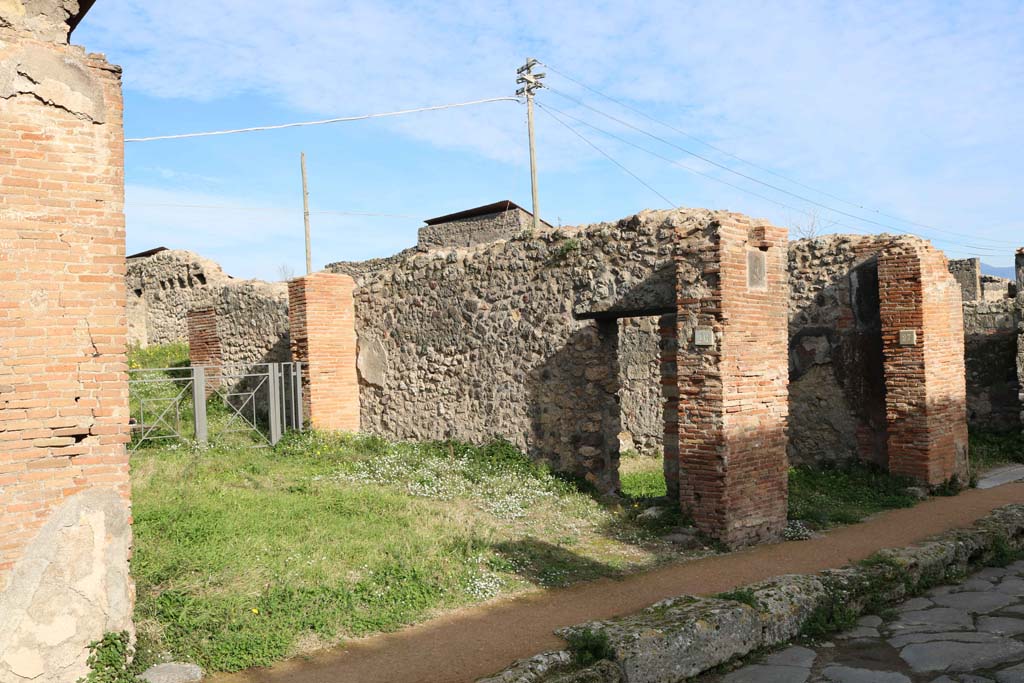
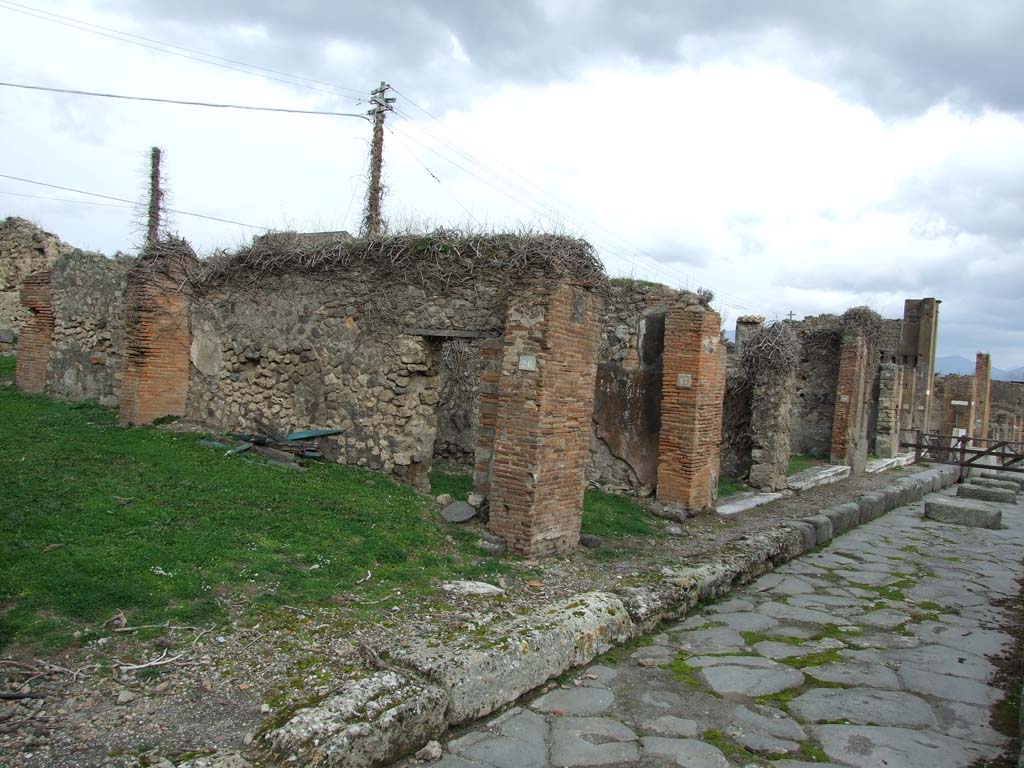
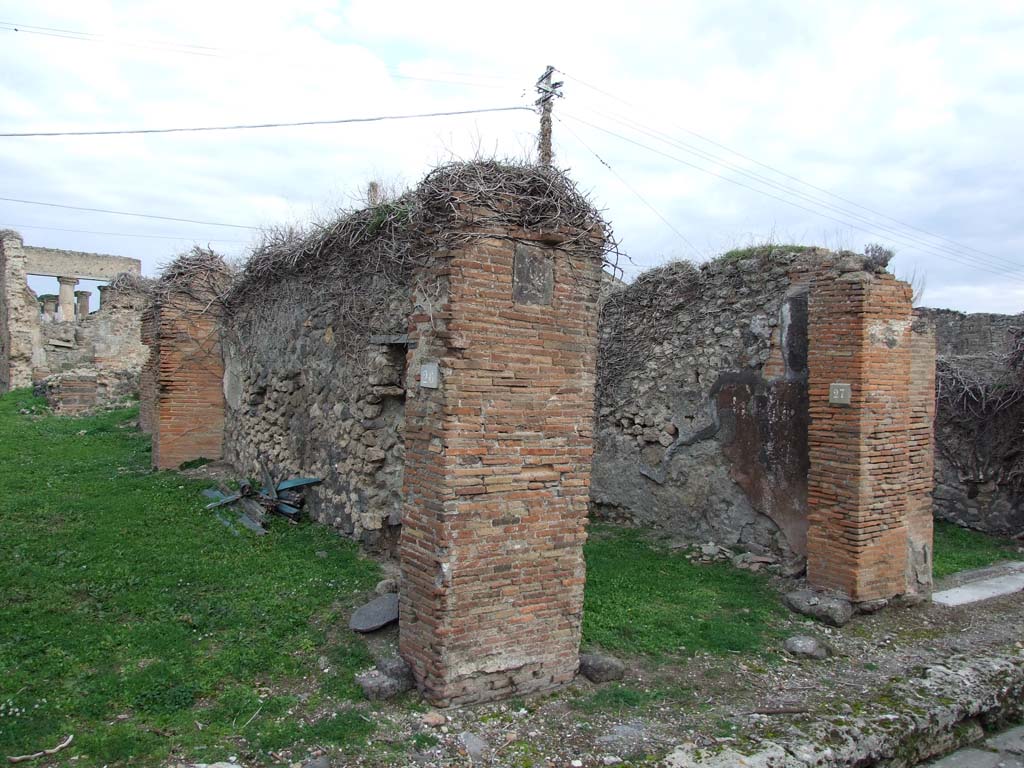
Looking east along Via degli Augustali from outside VII.4.26. December 2007.
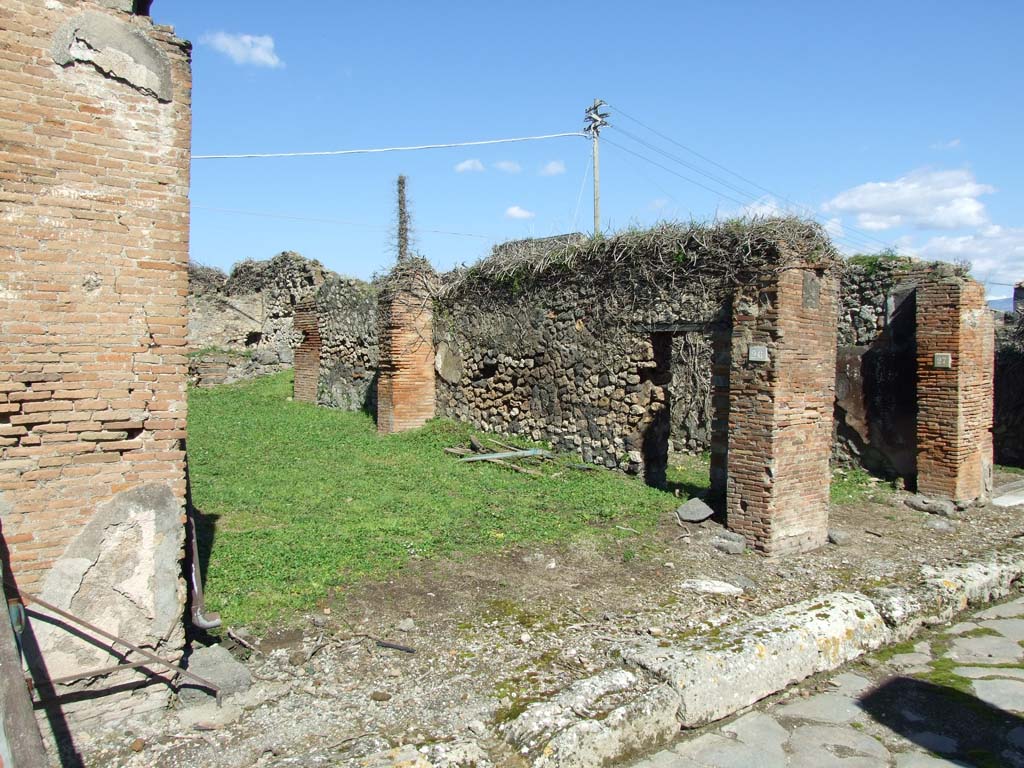
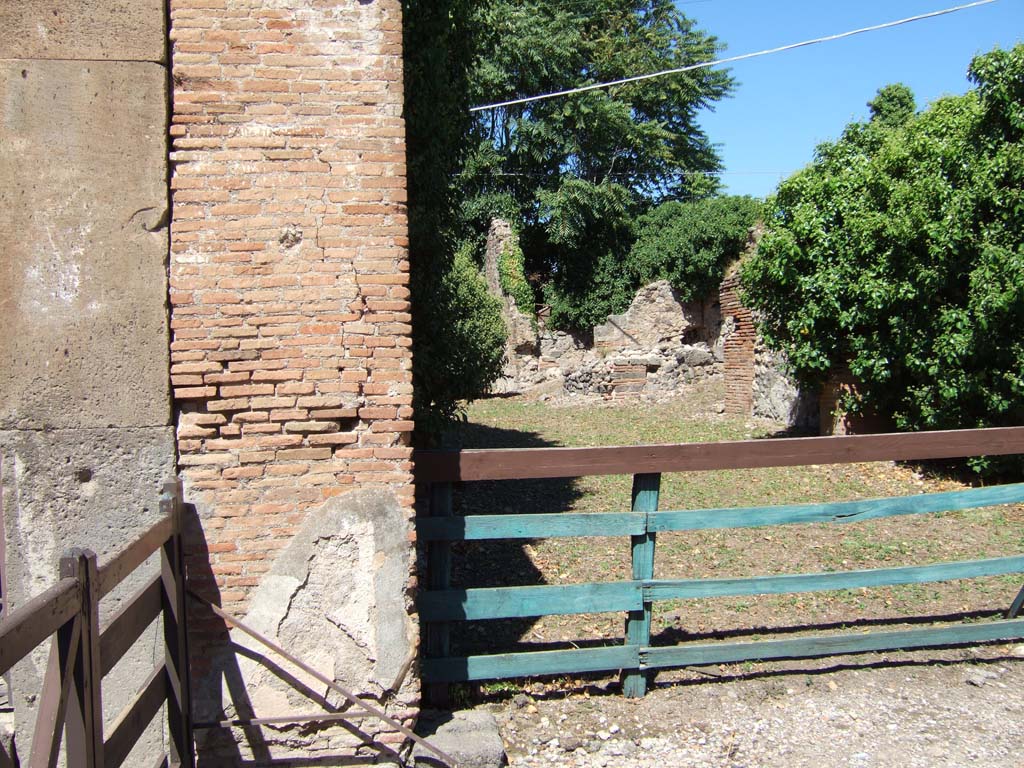
VII.4.26 Pompeii.
March 2009. Shop entrance on Via degli Augustali.
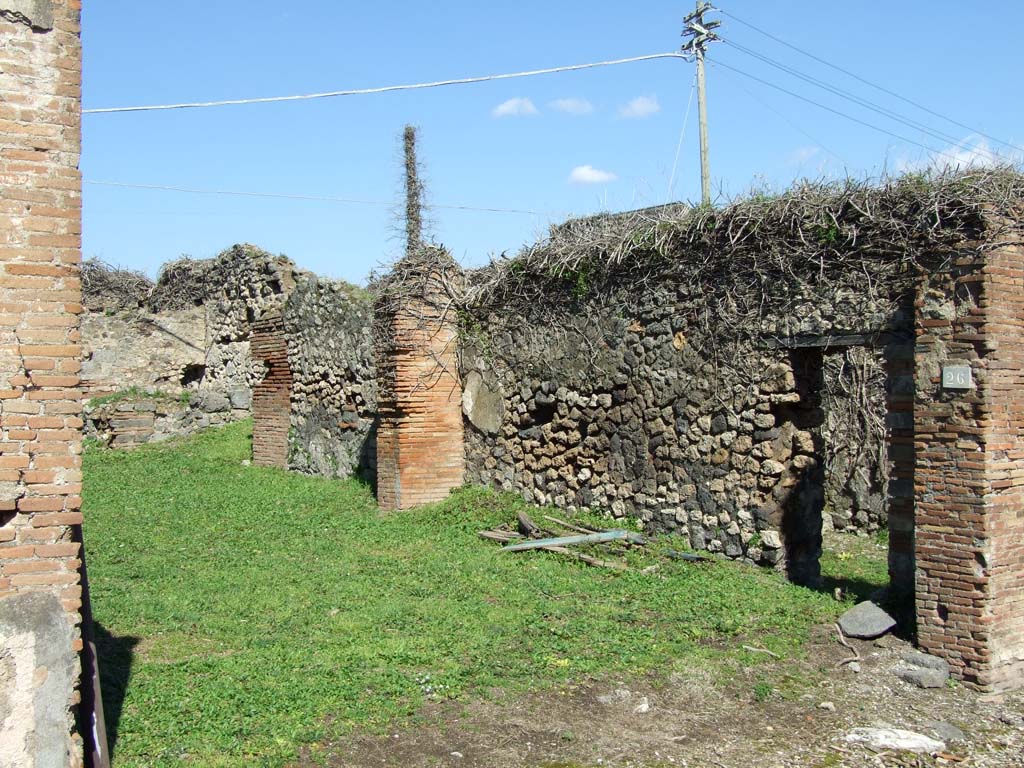
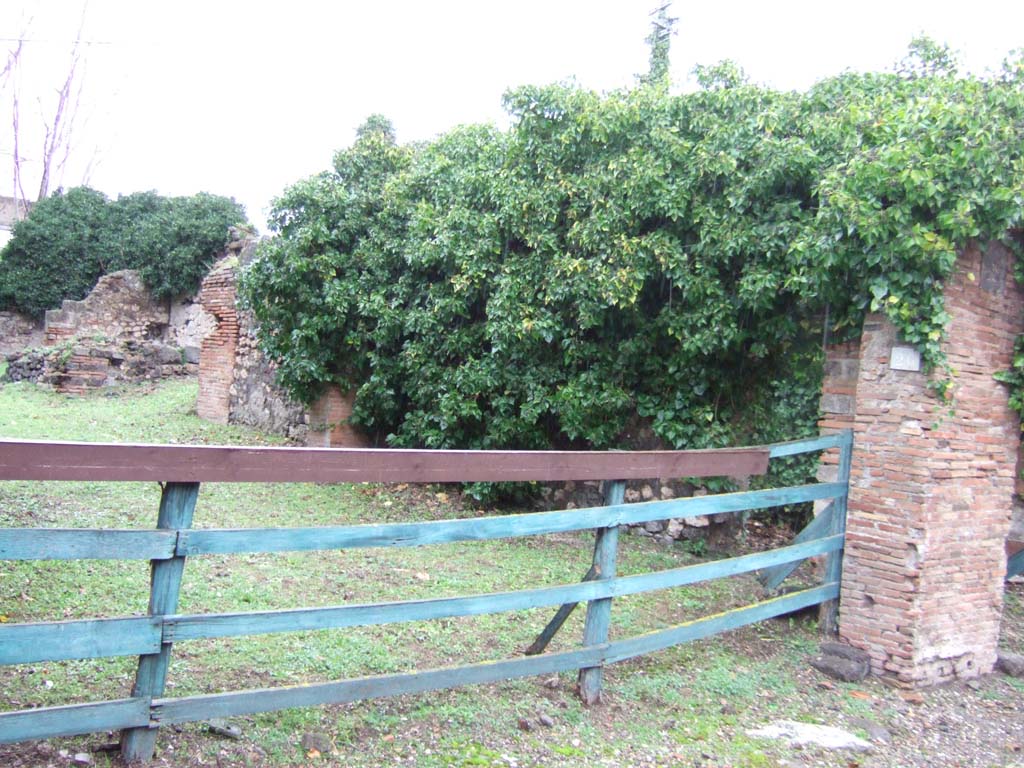
VII.4.26 Pompeii. March 2009. East wall with doorway to VII.4.27
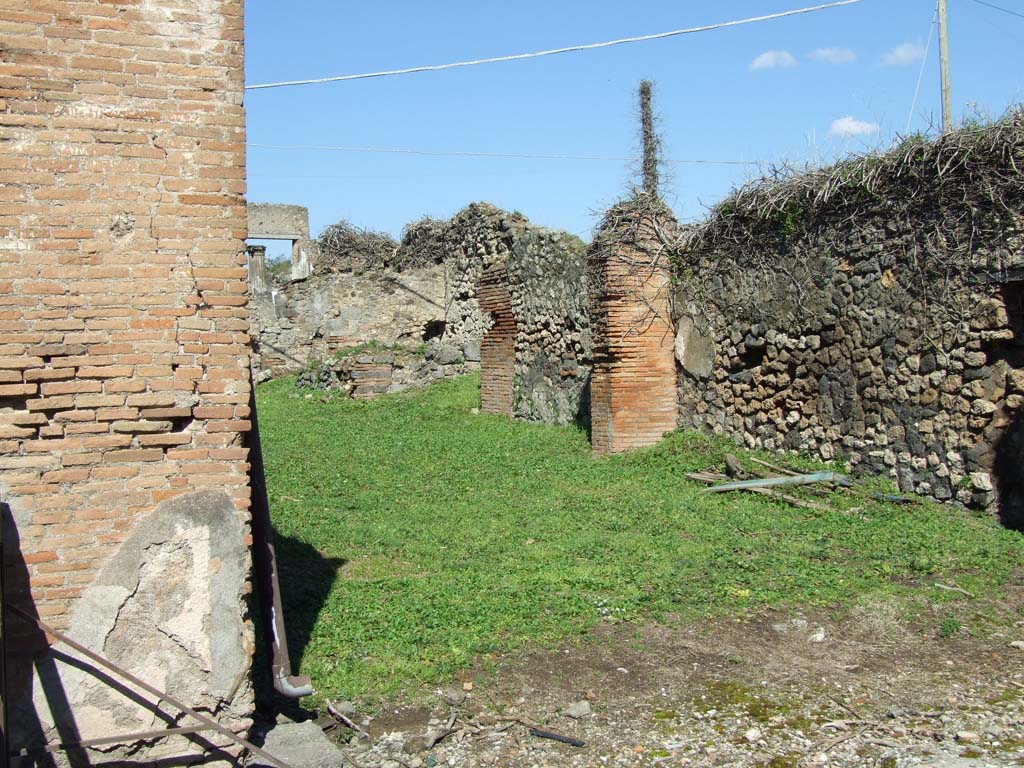
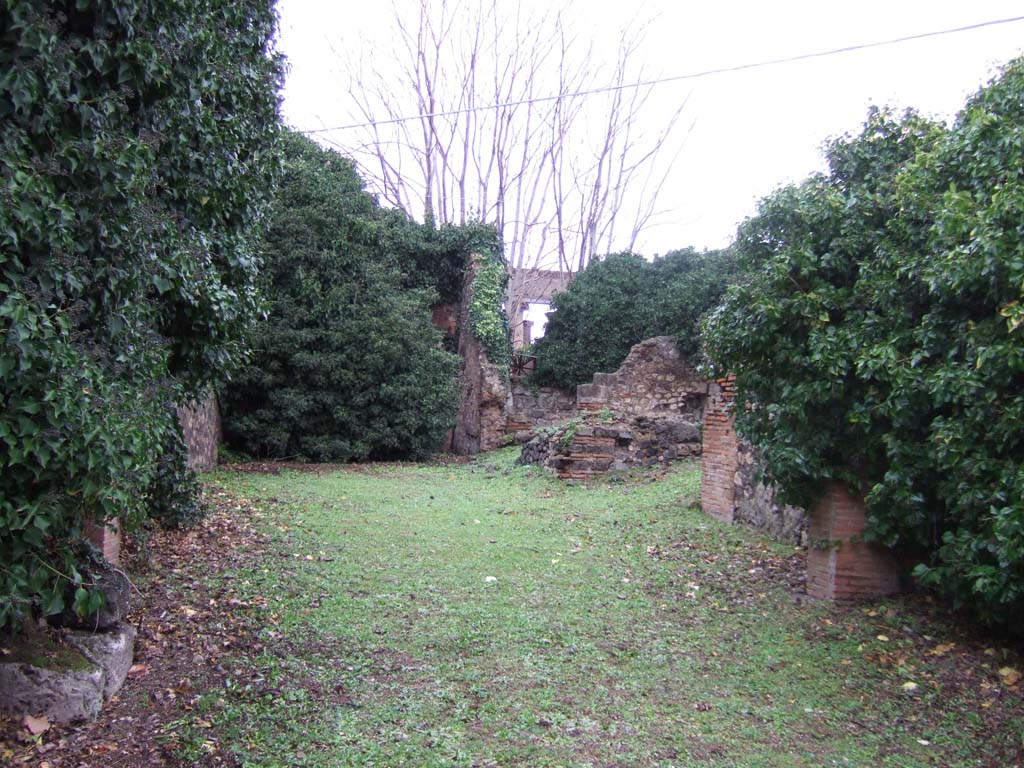
VII.4.26 Pompeii. March 2009. Looking north across shop towards rear rooms of dwelling.
Fiorelli reported that on the right side of the rear was a cubiculum with a scene of a gladiatorial combat with some animals.
According to Jacobelli, this particular subject was copied several times, and may or may not be the one in a drawing by Morelli.
She thought the similar painting described by Fiorelli may be one of the copies of this fashionable composition often found at Pompeii.
See Pappalardo,
U., 2001. La Descrizione di Pompei per
Giuseppe Fiorelli (1875). Napoli: Massa Editore. (p. 90).
See Jacobelli,
L., 2003. Gladiators at Pompeii.
Rome: L’erma di Bretschneider. (p. 76, and fig.64).
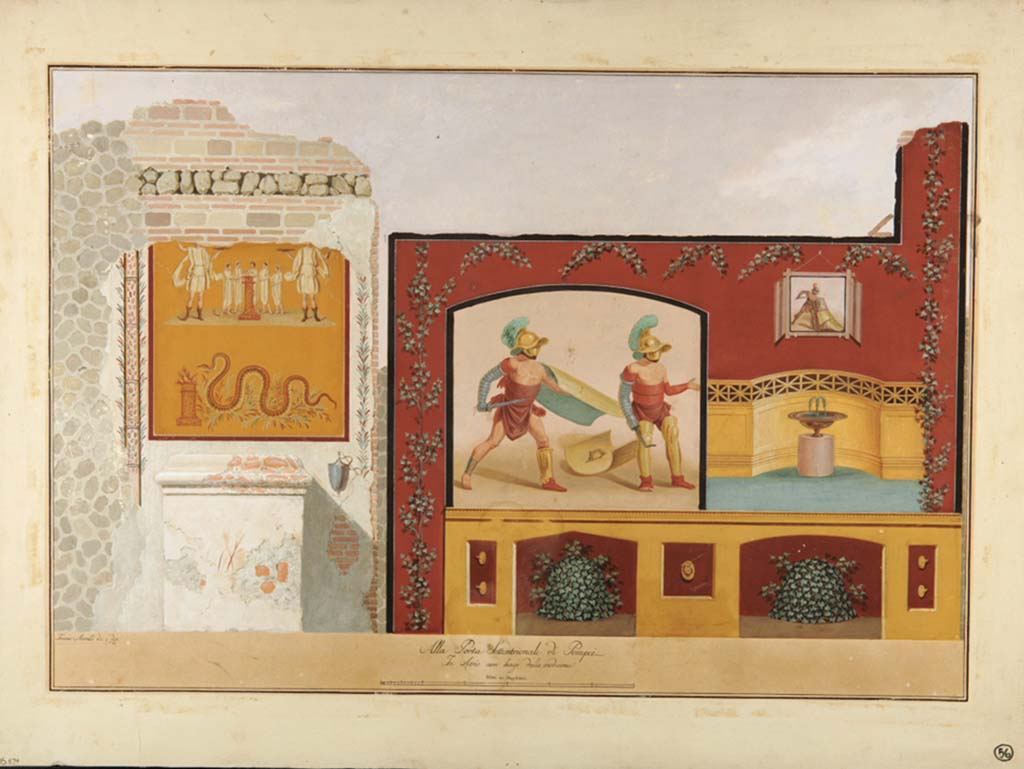
VII.4.26 Pompeii.
Painting by Francesco Morelli, written underneath is “Alla porta settentrionale
di Pompei in Atrio non lungi dalla medesima”.
(“At the
northern gate of Pompeii in an atrium not far from the same”). This would seem
to indicate one of the houses in Ins. Occidentalis.
This
painting by Morelli may or may not be the same one as found in this house, as
the subject was copied several times, see Jacobelli, above.
The
lararium, on the left, may belong to a different wall than the gladiators, but
the method of Morelli’s work probably meant even if not from the same wall, it
was from the same house. (However, see IV.4.g, where the same painting has been
located at by Frohlich.)
See Fröhlich, T., 1991. Lararien und Fassadenbilder in den Vesuvstädten. Mainz: von Zabern. (p.315, F24)
Now in Naples Archaeological Museum. Inventory number ADS 574.
Photo © ICCD. https://www.catalogo.beniculturali.it/
Utilizzabili alle condizioni della licenza Attribuzione
- Non commerciale - Condividi allo stesso modo 2.5 Italia (CC BY-NC-SA 2.5 IT)
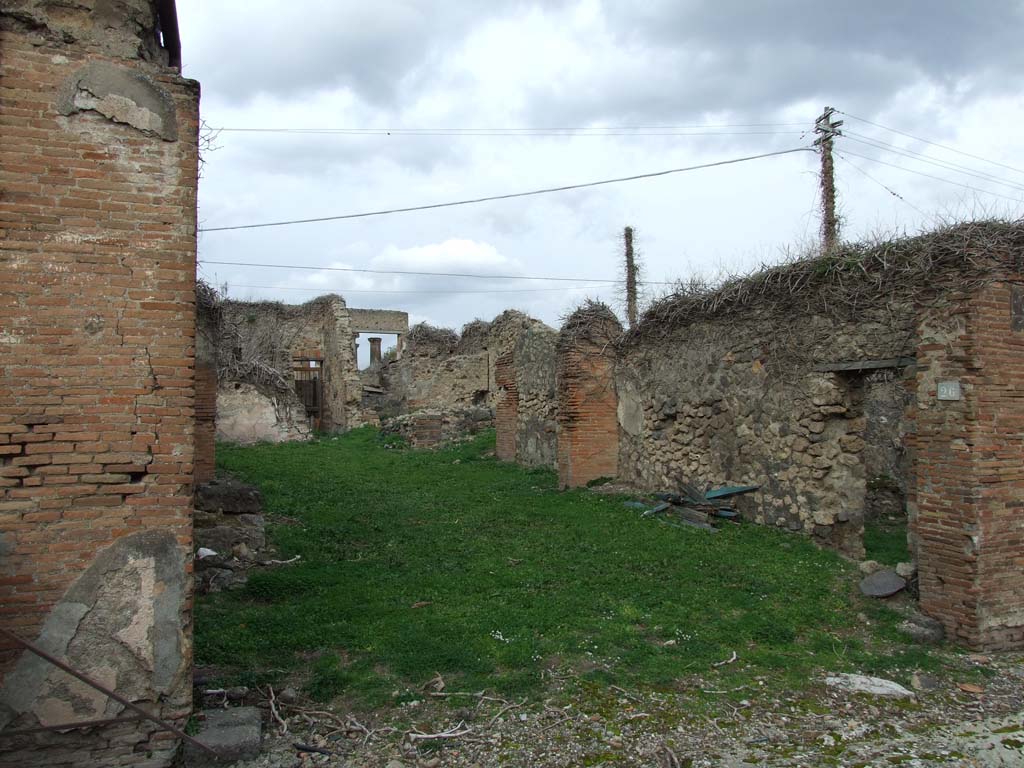
VII.4.26 Pompeii. December 2007. Shop entrance to workshop/dwelling.
According to Fiorelli, the atrium with an impluvium would have been at the rear of the shop-room, on whose right side would have been positioned the ala, the storeroom containing the stairs to the upper rooms, and the cubiculum decorated with gladiatorial scenes.
At the rear, there was a small room bordered by the corridor, as well as a triclinium with entrance from the same corridor, which in its length gave access to three other rooms, a small garden and the kitchen, which had a separate latrine, and in the wall against the hearth showed a painting with Hercules before the altar, assisted by the Tibicine between the two Lares: in the lower part of the painting were two men with an amphora, and other amphorae on a cart. On the side wall, were the painted serpents and table.
See Pappalardo, U., 2001. La Descrizione di Pompei per Giuseppe Fiorelli (1875). Napoli: Massa Editore. (p.90).
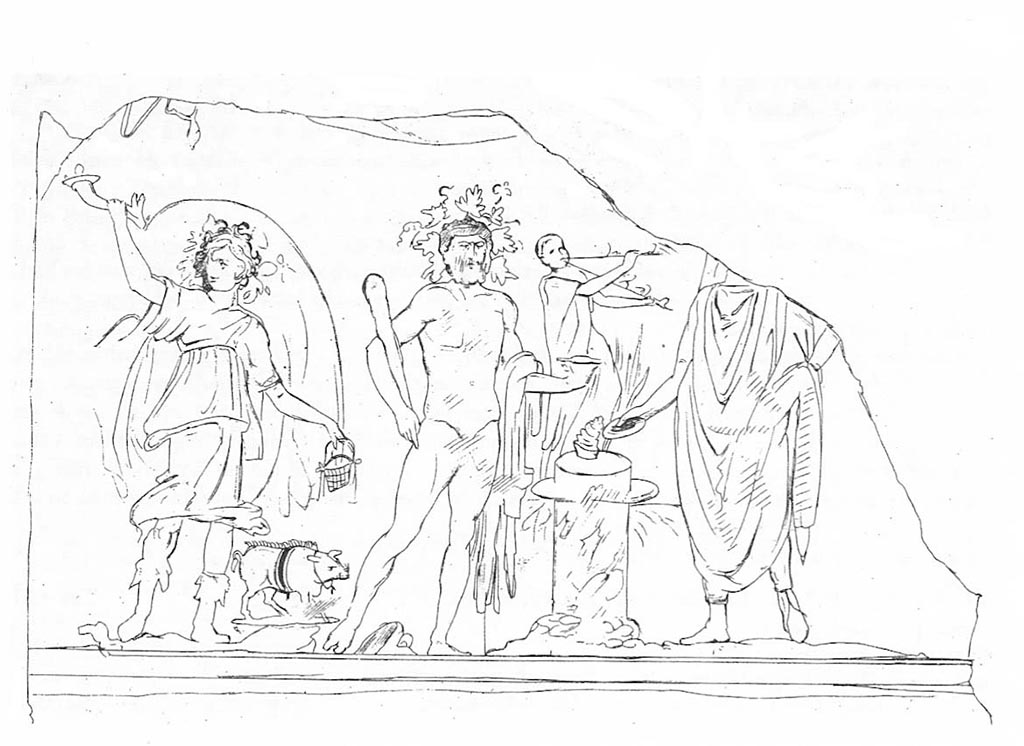
According to Boyce and Frohlich, the lararium was on the south wall of the kitchen on a white background.
Frohlich wrote that the painting has now faded and vanished.
On the right of a blazing altar stood the Genius, behind the altar the tibicen was visible.
On the opposite side of the altar stood Hercules and behind him was a hog with a bell around its neck.
On the left of this group stood a Lar of smaller stature than the others. The Lar on the right had vanished.
Below these figures were painted numerous objects, now faded, including flasks and amphorae.
To the right of these objects, two young men wrestle for the possession of an amphora, each holding onto one of the handles.
With their other hand they each hold onto each other’s hair.
The two serpents were painted on an adjoining wall.
See Boyce G. K., 1937. Corpus of the Lararia of Pompeii. Rome: MAAR 14. (p.65, no.273).
See Fröhlich, T., 1991. Lararien und Fassadenbilder in den
Vesuvstädten. Mainz: von
Zabern. (p.286, L85, Abb.7)
See Helbig, W., 1868. Wandgemälde der vom Vesuv verschütteten Städte Campaniens. Leipzig: Breitkopf und Härtel, 69, taf. III.
On 13th September 1943, a bomb fell destroying the corridor from the shop and another two rooms nearby.
This caused the loss of wall plaster painted in the fourth style.
See Garcia y
Garcia, L., 2006. Danni di guerra a Pompei. Rome: L’Erma di Bretschneider. (p.98)
According to Eschebach, the kitchen would have been at the rear of the dwelling.
See Eschebach, L., 1993. Gebäudeverzeichnis und Stadtplan der antiken Stadt Pompeji. Köln: Böhlau. (p.278)
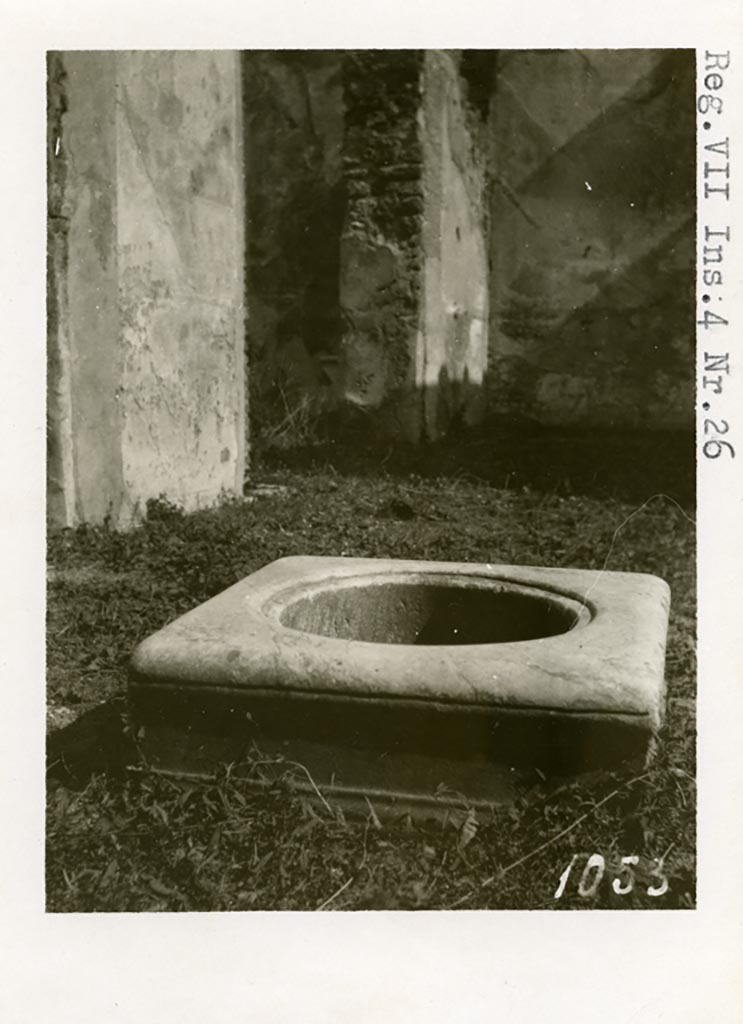
VII.4.26 Pompeii, according to Warsher. Pre-1937-39. Cistern mouth.
Photo courtesy of American Academy in Rome, Photographic Archive. Warsher collection no. 1053.