VI.16.31 Pompeii. Workshop/dwelling. Excavated 1905.
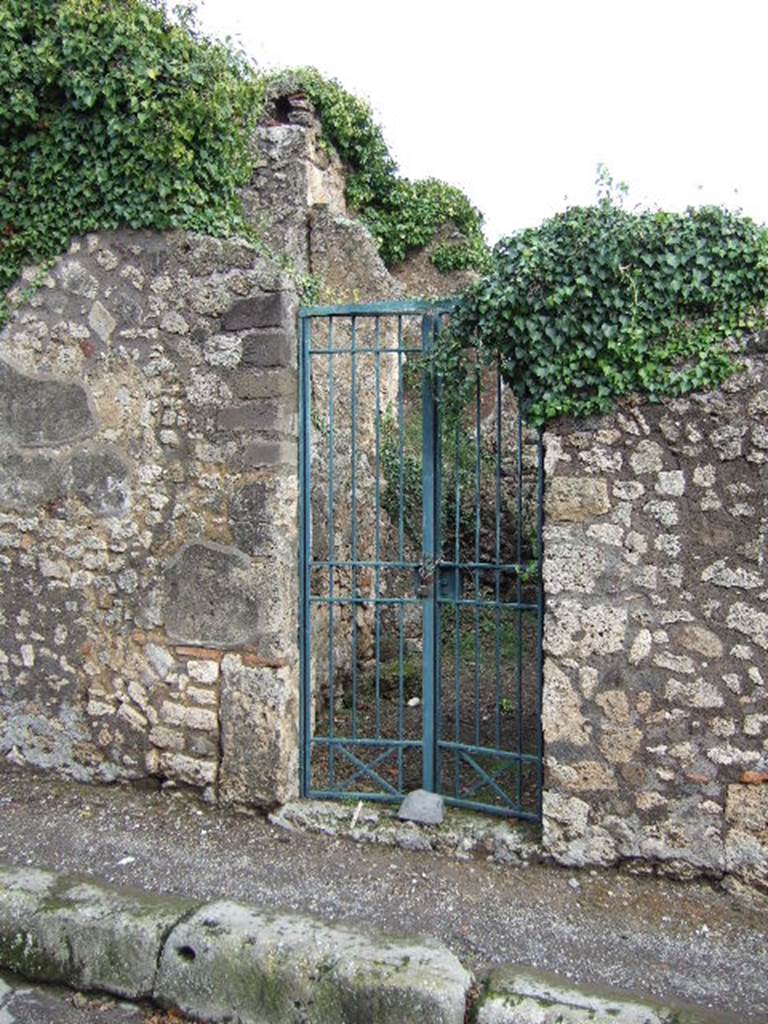
VI.16.31 Pompeii. December 2005. Entrance doorway, looking east.
According to NdS, when discovered this doorway was without a threshold
See Notizie degli Scavi di Antichità, 1908,
(p. 285-287)
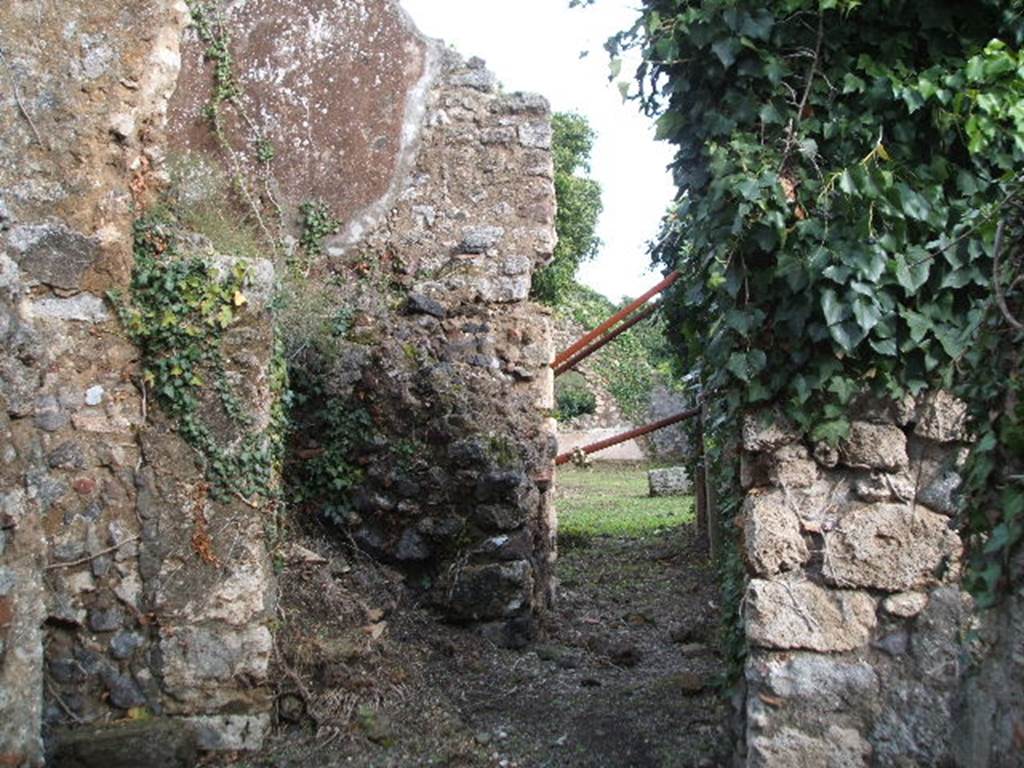
VI.16.31 Pompeii. December 2004. Looking east from entrance doorway.
The doorway led immediately into a short and wide fauces A, with earth floor and rustic walls.
In the centre left of this photo can be seen the remains of the ramps of masonry stairs that led above.
On the left of this photo was a doorway into a large room B, which was as rustic as the corridor.
In the top of the west wall was a window, and there was a niche in the south wall.
In the south-west corner was a low masonry structure.
According to Eschebach room B was the kitchen.
See Eschebach, L., 1993. Gebäudeverzeichnis und Stadtplan der antiken Stadt Pompeji. Köln: Böhlau. (p.231)
According to Boyce, in the kitchen (?) on the left side of the fauces, in the south wall above the hearth (?) was a rectangular niche (h.0.30, w.0.22, d.0.22, height above the floor 1.50).
See Boyce G. K., 1937. Corpus of the Lararia of Pompeii. Rome: MAAR 14. (p.59, no.228)
According to Giacobello, in the kitchen (room E) was a niche on the south wall, near the hearth.
Today there is no trace.
See Giacobello, F., 2008. Larari Pompeiani: Iconografia e culto dei Lari in ambito domestico. Milano: LED Edizioni. (p.186)
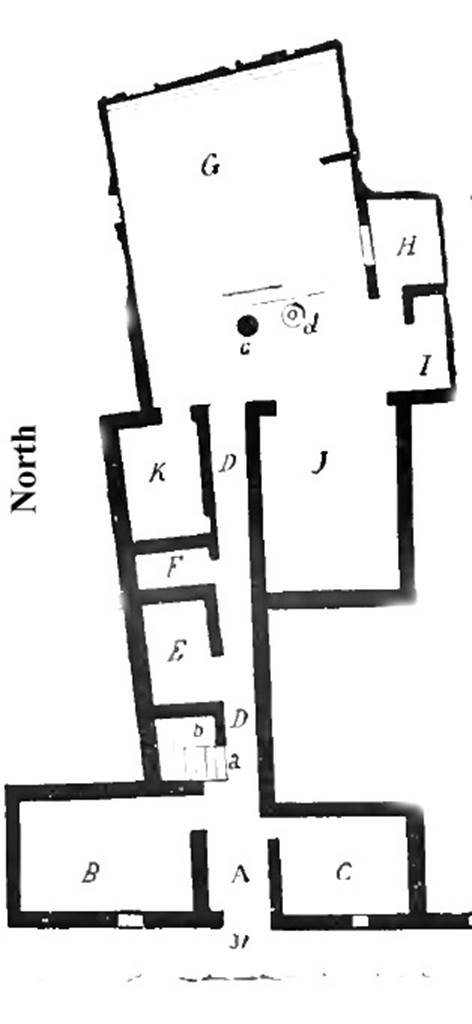
VI.16.31 Pompeii. 1908 excavation plan of house.
See Notizie degli Scavi di Antichità, 1908,
(p. 272, fig. 1).
On the left of fauces A was a doorway into a large room B, which was also as rustic as the corridor.
In the top of the west wall was a window, and there was a niche in the south wall.
In the south-west corner was a low masonry structure.
Room C was on the right of the fauces, almost opposite the doorway to room B.
This was a smaller room but also rather rustic.
In the west wall was a window, and in the north-west corner was a low masonry structure.
A long and narrow corridor D then led to the rear of the house, and to a courtyard G.
At the north-west end of corridor D could be seen the remains of two ramps of masonry stairs (a) and (b) that led to a mezzanine level.
Two rustic rooms E and F were on the north side of corridor D.
In the north wall of room E, the holes for the beams that supported an upper room, could be seen.
Room F was the latrine.
Room K, was a cubiculum on the north side of the corridor D, but its doorway opened under the portico of courtyard G.
It had a cocciopesto floor and faint traces of a simple painted decoration consisting of vertical yellow bands that divided the white background of the walls into panels.
Above it ran a cornice of stucco, of which remains could be seen in the north-east corner.
In the same corner, above the holes for the large beams, a small bit of floor of an upper room could be seen.
Here, one could also see a bit of preserved high dado of the upper room.
In the north wall was a window, and in the south wall was a recess for the bed.
Room J was on the south side of corridor D, and it had a wide doorway onto the portico of courtyard G.
It was a large room with walls of painted cocciopesto.
The walls were divided into large panels, three on the west side and five on the long north and south sides.
The lower dado was black, and the frieze was on a white background, but only preserved to the south, with some paintings with fruit and birds.
The central painting on the north wall was lost, the one on the west wall was only preserved in its lower half.
This had a mountainous scene, with a stream, animals drinking, two unrecognisable figures and, in the background, a sanctuary.
The central painting from the south wall was the best preserved, although its interpretation is uncertain.
It contained a sacred landscape with a tree, temple, virile statue, a high pole with at its top a horizontal disc with protruding points and a quiver was attached to the pole.
The portico on the west side of courtyard G was supported by a masonry column (c), the lower part was painted red with white plaster above.
Near to the column (c) was a cistern mouth (d) with a large terracotta puteal.
In the courtyard G, a large number of terracotta amphorae were found, of various types and sizes. They were to be left in place.
The courtyard G had rough rustic walls and was partly paved and partly gravelled.
On the south side of the portico was a small room I, rectangular and rustic, used perhaps as a large cupboard.
Room H, also on the south side of the courtyard G, was another small room with floor of mortar embedded with pieces of marble.
Its walls, which originally were coated with slabs of imitation white marble, were destined to receive a new decoration with their other new layer of plaster.
See Notizie degli Scavi di Antichità, 1908,
(p.285-287).
.