I.1.6 Pompeii. Shop with dwelling. Linked to I.1.7, I.1.8 and I.1.9.
Excavated 1872.
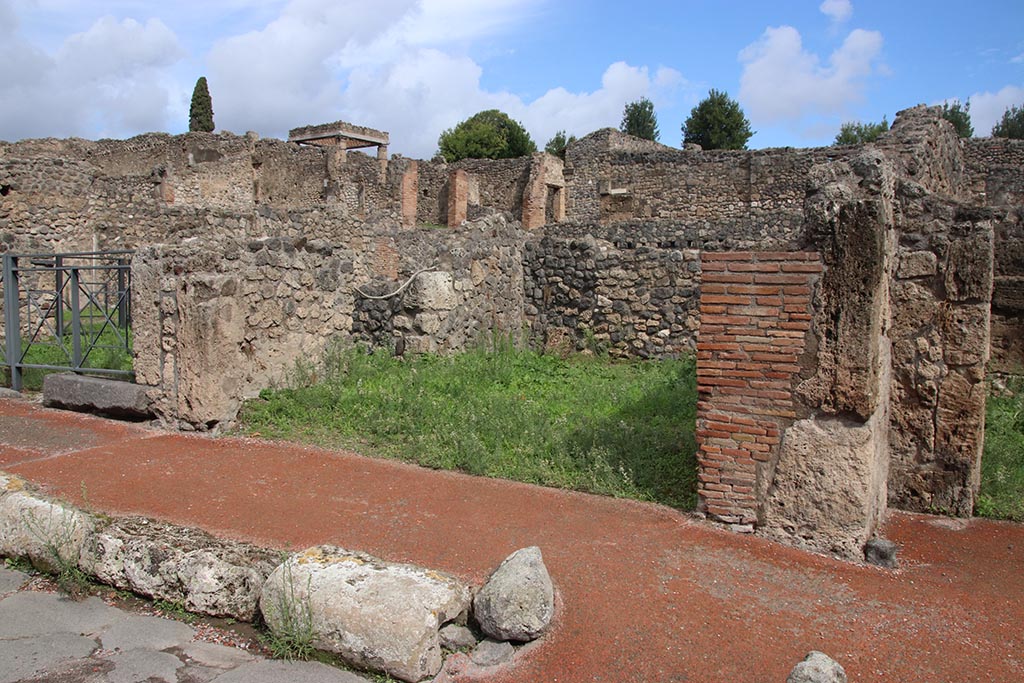
I.1.6 Pompeii. October 2024. Looking towards entrance doorway on east side of Via Stabiana. Photo courtesy of Klaus Heese.
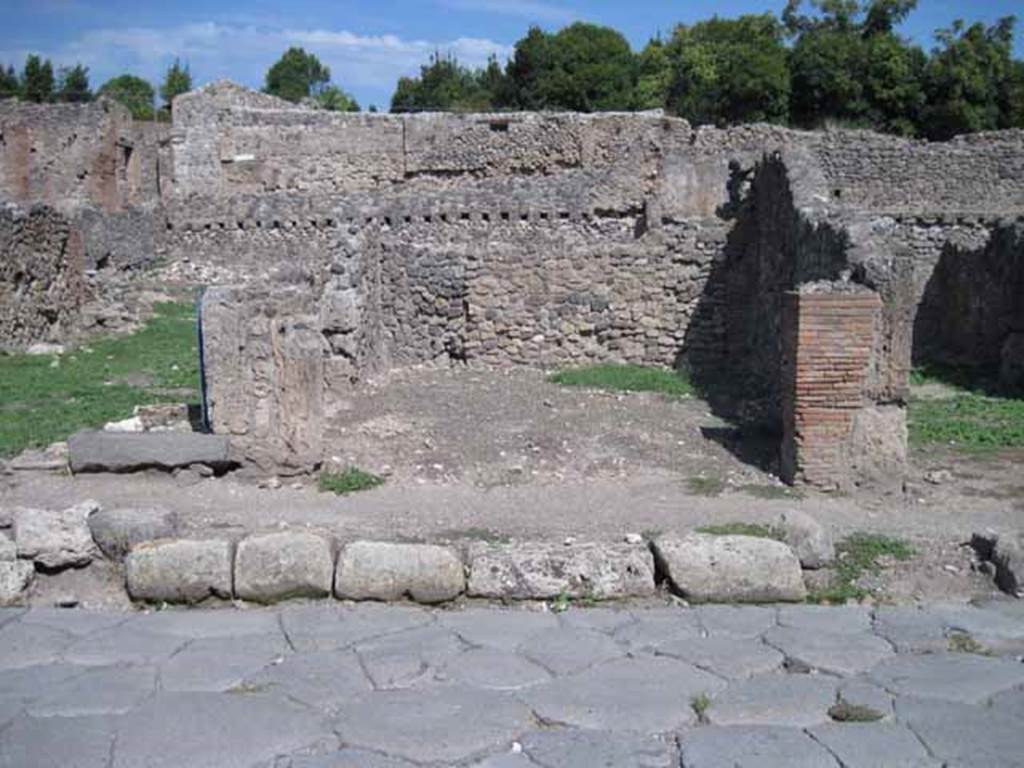
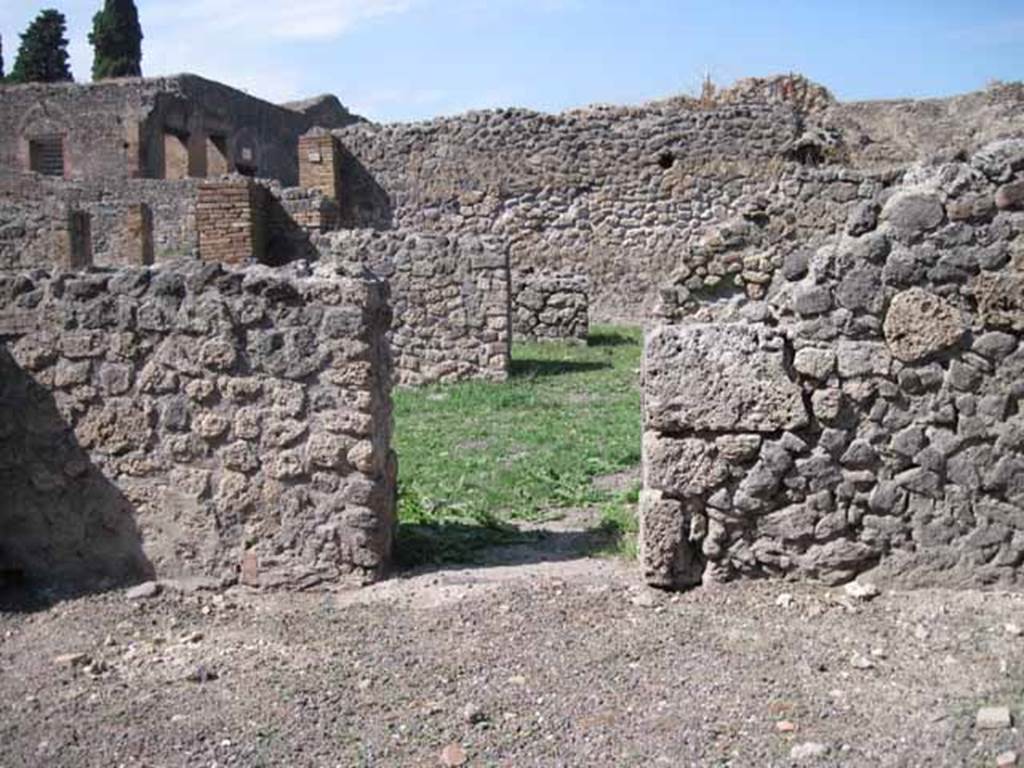
I.1.6 Pompeii. September 2010. Looking east towards entrance on Via Stabiana. Photo courtesy of Drew Baker.
According to Warscher, quoting Mau in Bull. Inst 1875, p.30,
I.1.6-9: “Segue
un altro albergo, molto simile a questo descritto. Qui pure è interrotto il marciapiede per lasciar
entrare i legni.
L’entrata era chiuse mediante una porta a quattro partiti, congiunti a
due adue, come si conosce dai quattro buchi per i chiavistelli.
Qui pure si
entra prima in un compreso che ha le dimensioni d’una bottega grande con una
dietrobottega e posteriormente si apre sopra una grande corte, lungo il cui
muro di fondo qui pure si stende la stalla, larga 13,30, profonda 2,47 con una
finestra sul vico settentrionale e due porte, una all’estremità meridionale,
l’altra poco distante da quella settentrionale.
Presso a
quest’ultima una parte della corte è selciata.
Lungo il muro
N vi sono due camere con finestre sul medesimo vico, e prossimo alla stalla il
cesso.
Si vede anche
il cesso del piano superiore e i tubi di mattone d’un terzo, che stava ancora
più in alto.
Nell’angolo NO
vi sono i primi gradini d’una scala, la cui parte superiore sarà stata di
legno, in quello SO l’apertura della cisterna, e accanto nella stessa massa di
materiale una vasca lunga stretta e bassa, come quella sudescritta nella casa
adiacente.
Qui la vediamo
frapposto fra la cisterna ed il muro di O, il che esclude categoricamente
l’aver essa servito d’abbeveratoio.
Dalla parte
più bassa di essa, aperta come nella casa sudescritta, l’acqua colava in
un’altra vasca larga 1,02 x 1,54, di cui un lato viene formato dalla suddetta
massa di fabbrica, uno dal muro occidentale, i due rimanenti da appositi
muricciuoli.
Essa ha al
fondo uno scolo verso N, che dà in un vaso ossia tubo di mattone, incastrato
nel suolo.
Nella parete
vi era la pittura dei Lari, di cui sono rimasti soltanto i serpi.
A destra
dell’ingresso per i legni sta un locale come una bottega.
L’essere esso
congiunto mediante una porta con quel primo compreso, ove entravano i legni, ci
lascia supporre, aver esso servito di caupona per i vetturini”.
See Warscher T., 1935. Codex Topographicus Pompeianus: Regio I.1/I.5. (no. 14), Rome: DAIR.
(translation: “I.1.6-9: Another hotel followed, very
similar to that already described. Here
also the pavement was interrupted to allow entry for the “carts?”/the wood?.
The entrance was
closed by a door of four entries, joined two by two, as you knew from the four
holes for the bolts.
Here we entered
first into a complex that had the dimensions of a large shop with a rear-room
and behind, it opened onto a large courtyard, along whose rear wall was the
stable, l3,30 wide, 2,47 deep, with a
window onto the northern roadway and two doorways, one at the extreme southern
end, the other not far from the north. Near to this last, a part of the
courtyard was paved. Along the north wall there were two rooms with windows
onto the same roadway, and the toilet was next to the stables. Also, you could see the toilet on the upper
floor and the brick pipes of a third, which was even higher still. In the
north-west corner, there were the first steps of a staircase, the upper part
would have been of wood, in the south-west was the opening of the cistern, and
nearby in the same mass of material there was a long narrow and low basin, the
same as that described in the adjacent house. Here we see it came between the cistern
and the west wall, which excluded categorically that it was used as a drinking
trough. From the lower part of it, open as in the described house, water strained
into another large basin 1,02 x 1,54, one side of which was formed by that mass
of masonry, one from the western wall, the two remaining from suitable low walls. It had at the bottom a drain to the north,
which went into a jar or brick (terracotta?) pipe, buried in the ground. On the
wall there was the painting of the Lares, of which only the serpents remained. To
the right of the entrance for the carts, was a room like a shop. This was
connected through a door with that first area, where the carts entered, which
allowed us to suppose, it had been used as a caupona for the carters.”)
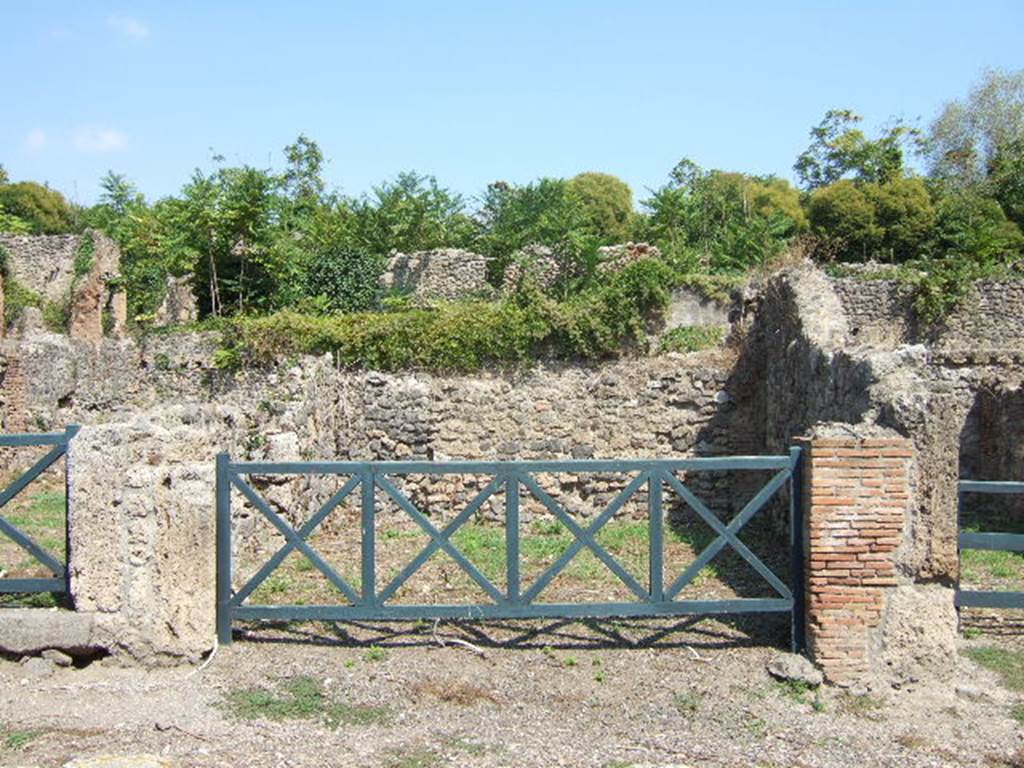
I.1.6 Pompeii. September 2005. Entrance to shop, linked to another inn at I.1.8.
See - Packer, Jim, Inns
at Pompeii: a short survey. In Cronache Pompeiane, IV, 1978, (p.6-9).
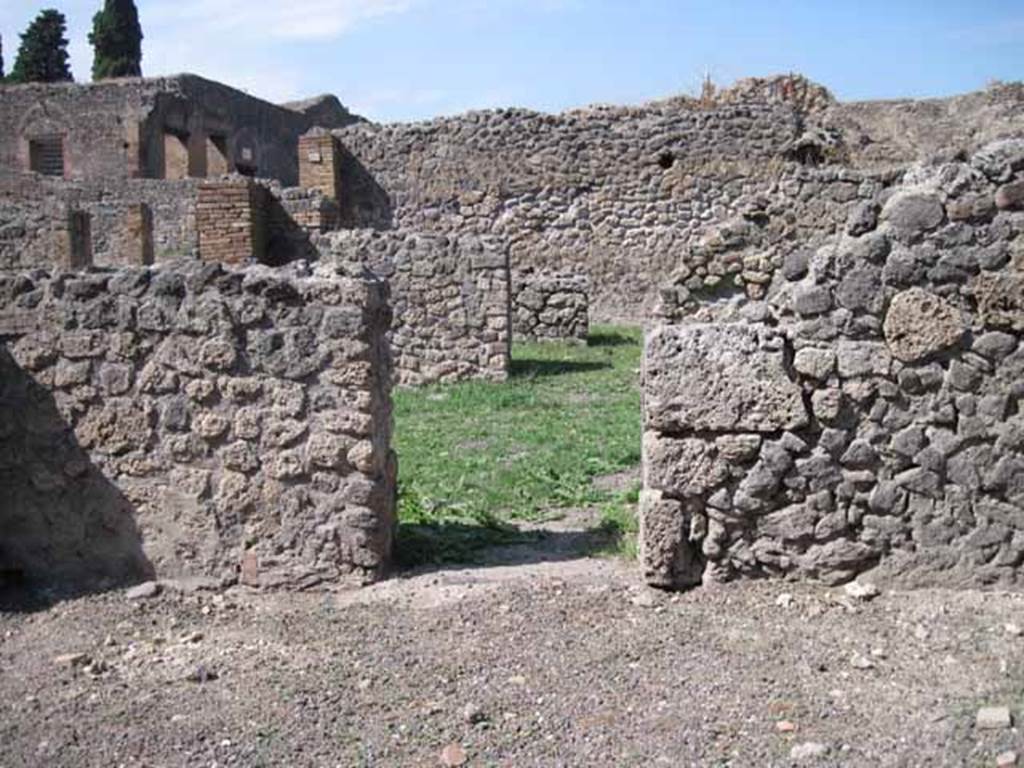
I.1.6 Pompeii. October 2024.
Looking east across shop-room, with doorway in north wall into I.1.8, on left. Photo courtesy of Klaus Heese.
I.1.6 Pompeii. September 2010. Doorway in north wall leading to large room of I.1.8. Photo courtesy of Drew Baker.
In Codex Topographicus Pompeianus: Regio I.1/I.5, (the copy at DAIR), Warscher included Viola’s description of the insula, from
Gli scavi di
Pompei dal 1873 al 1878, introduzione (Pompei e la regione sotterrata dal
Vesuvio nell’anno 1879, Napoli, 1879).
This is included at the end in all parts of I.1 on the website.
“Parlando
dell’Insula I, Regio I – dicevo che in origine essa dovette essere unita
all’isola V, la quale ha ricevuto questo numero sol perchè scavata
posteriormente alle altre quattro della stessa regione. La causa per cui questo spazio fu per mezzo
di un vico diviso in due parti noi la ignoriamo, laddove non si può porre in
dubbio che tutta questa seconda parte dovette appartenere a un solo
proprietario, perchè quasi tutta occupata da un solo edifizio; che le altre due
ristrettissima località furono ricavate posteriormente.
La sua area è
di m.q. 1595-72: ed è limitata a settentrione dalla via tertia, che la separa
dalla isola 2, ad oriente ed occidente da due vicoli privi di selciato, e a
mezzogiorno dell’agger che fiancheggia le mura; senza dubbio essa faceva parte
de’quartieri ignobili della città, almeno per quanto può congettarsi dal
mestiere che vi si esercitasse e della rozzezza della costruzione. Anche quivi avvennero frequenti
trasformazioni, come affermano gli avanzi di costruzioni appartenenti a diverse
epoche.
Come si vede
dalla prefazione del prof. Viola – fu un malintese con la numerazione delle
insulae della Regio I: non si aspettava che vi fosse un vicolo che separa
l’insula I dell’insula vicina, e a questa altra fu dato il numero 5 – poichè i
numeri 2, 3 e 4 sono stati dati alle insulae scavate prima. Ma io sono dell’opinione che sia meglio non
cambiare i numeri una volta dati, poichè sarebbe troppo difficile di orientarsi
nei rendiconti contemporanei agli scavi.
Il vicolo che
separa l’insula I della insula 5 – dà l’impressione di un passaggio stretto,
nessuna porta, nessuna finestra non danno in questo vicolo.
La mia
fotografia è molto tipica per l’insula intiera: muri di tufo o di pietra di
Sarno completati nell’epoca tardiva di mattoni; non è possibile di seguire i
cambiamenti che avevano luogo nell’insula in questione. Noi abbiamo, come si vede tre case con
thermopolia, cauponae per la gente povera.
Non è rimasta
niente della pittura murale”.
See Warscher T., 1935. Codex Topographicus Pompeianus: Regio I.1/I.5. Rome: DAIR.